PHARMA & HEALTHCARE

Commercial Programs Built for the Regulated Environment of Pharma and Healthcare

DAM Networks pharma marketing consulting and commercial programs are built around regulatory parameters from day one. Integrated technology, marketing, and events for pharmaceutical and healthcare organizations.

SFA adoption above 85% within first quarter post-launch
MLR cycle time reduced from 21 to 11 working days
96% LMS completion rate at product launch
34% increase in HCP-initiated field conversations post-conference
THE CHALLENGE

The Pharma Commercial Challenge

There is a specific failure pattern that recurs across pharmaceutical commercial programs. The marketing team commissions a digital campaign. Legal and medical review happens at the end. The content comes back with revisions. The campaign launches six weeks late into a window that no longer aligns with field activity. The field force, meanwhile, is working in an SFA system they were trained on once and now use at 54% completion. The conference from last quarter generated 800 delegate records that are sitting in a spreadsheet with no connection to the CRM.

Each of these problems has a separate owner. Nobody owns the program.

The challenge for pharma commercial leaders is not a shortage of vendors. It is that most vendors are built for one function: the digital agency does not understand the field force, the events company does not understand MLR, the technology integrator does not know the difference between promotional and non-promotional content. Organizations end up with four vendors solving four parts of the same commercial problem while nobody is accountable for the commercial outcome.

Standard approaches from general consultancies carry a related problem. MLR review cycles, ABPI and MCI code requirements, fair market value calculations for healthcare professional engagements, and the operational distinctions between HCP-directed and HCO-directed programs are not things organizations learn on the job during your engagement. Pharma commercial programs require a partner who arrives knowing the terrain.

OUR PRACTICE

DAM's Pharma Practice

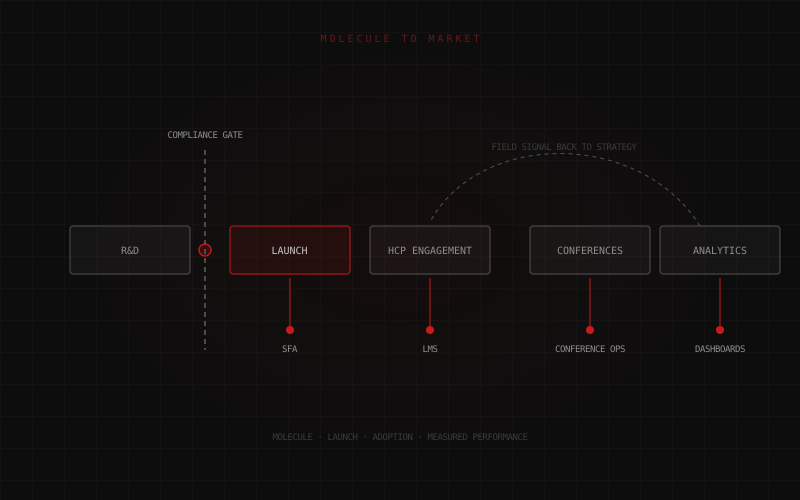
DAM Networks operates across four capability areas within pharma and healthcare, each staffed with professionals who understand the commercial and regulatory context specific to the industry.

TECHNOLOGY

Pharma Technology

Sales Force Automation

A pharma sales force automation implementation is not a CRM project. It is a behavioral change program with a CRM at the center. The difference matters because most SFA deployments are evaluated at go-live based on whether the system works. The business question is whether the field force uses it, uses it correctly, and whether the data it produces is actually informing territory strategy and coaching.

DAM approaches SFA implementation starting with a mapping of current field workflows, call planning behaviors, and manager reporting needs before a system configuration decision is made. The implementation is designed around how the field force actually operates, not how a default system configuration expects them to operate. Field force adoption rates above 85% within the first quarter post-launch are a consistent benchmark in our implementations compared to the industry average that frequently sits below 65% at the same point.

Post-go-live, the practice includes field force enablement programs, manager coaching tool configuration, and integration between SFA activity data and marketing automation to close the loop between field calls and digital HCP touchpoints.

HCP Engagement Platforms

Pharma digital transformation in the commercial context centers on HCP engagement platforms that can deliver personalized content at scale while maintaining the governance infrastructure that MLR and regulatory codes require. The platform design challenge is that personalization logic and regulatory defensibility are often treated as opposing requirements. They are not, but resolving that tension requires the platform to be architected with both requirements as first-order constraints.

DAM's platform work in this area covers channel orchestration across email, portal, field detailing, and event touchpoints, with content versioning and approval tracking built into the platform workflow rather than managed through separate systems.

Learning Management Systems

A pharma LMS that is not completed before a product launch is a compliance exposure, not a training program. DAM's LMS implementations for pharma clients include completion dashboards visible to line managers, automated escalation sequences tied to launch timelines, and mobile-first delivery for field representatives who complete training between calls.

Healthcare Software Development

For organizations building proprietary clinical or commercial infrastructure, healthcare software development requires engineering teams who understand HL7 and FHIR data standards, the access control requirements of healthcare data environments, and the validation requirements that apply to systems used in regulated processes. DAM's software development practice in healthcare covers patient engagement platforms, provider portal development, and custom commercial tools built for environments where data governance is not a feature request but a baseline requirement.

MARKETING

Pharma Marketing

Regulatory-Compliant Digital Programs

The measure of a pharma marketing agency is not creative quality in isolation. It is creative quality within a regulatory framework, delivered on a timeline that respects both the commercial calendar and the MLR review cycle. DAM structures pharma marketing programs with MLR integration as a workflow element, not a downstream approval gate. In practice, this approach reduces average MLR cycle time per asset, with clients seeing review-to-approval timelines improve from 18–22 working days to 9–12 working days through structured process rather than regulatory shortcuts.

HCP Engagement Campaigns

HCP engagement through digital channels requires a different framework than consumer or B2B marketing. The audience is small and specialized. The content must be clinically accurate, code-compliant, and relevant to the prescribing or referral context of the specific HCP segment. Reach is less important than relevance, and a program that drives HCP-initiated conversations with the field force is worth more than one that generates impressions from HCPs who are not in the relevant prescribing category.

Medical Device Marketing

Medical device marketing sits in a different regulatory context than pharmaceutical promotion, with distinct requirements around clinical evidence standards, indication claims, and the separation of promotional and clinical content in regulated markets. DAM's device marketing practice covers digital channel programs aligned to regulatory requirements for the relevant device classification, clinical conference presence and follow-up programs, and account-based engagement approaches for health system and hospital customers.

Content Operations and Channel Integration

At scale, pharma marketing generates a volume of content variants by indication, by HCP specialty, by channel, by market that requires a content operations infrastructure. DAM builds content governance frameworks that connect brief to approval to distribution across field force, email, portal, and paid digital channels, with version control that satisfies both brand consistency requirements and the audit trail that regulatory teams need.

EVENTS

Pharma Events

Medical Conferences and Symposia

Medical conference management for pharmaceutical organizations is a commercial and compliance program, not a logistics exercise. DAM manages medical conferences and satellite symposia across ABPI, MCI, PhRMA, and equivalent regulatory environments, with program design that starts from the fair market value framework for faculty honoraria, the permitted hospitality parameters, and the post-event reporting requirements before the venue is selected or the scientific agenda is built. See our conference management practice for broader event capability.

National Sales Meetings and Field Force Activation Events

A national sales meeting is one of the highest-cost items in a pharmaceutical commercial calendar, and the return on that investment is determined almost entirely by program design, not production quality. DAM designs national sales meetings as commercial programs, with content developed in alignment with the medical and marketing teams responsible for the product strategy, field force breakout sessions built around the specific commercial challenges of each region or therapy area team, and a post-event engagement plan that reinforces the priorities introduced during the meeting.

CME and Medical Education Events

CME programs and accredited medical education events require a separation between commercial intent and educational content that is both a regulatory requirement and a credibility requirement with the HCP audience. DAM manages CME programs with independent scientific planning support, faculty selection based on clinical expertise, and accreditation compliance for ACCME, CME India, and equivalent bodies.

KOL Engagement Events

KOL engagement events advisory boards, clinical roundtables, investigator meetings carry a specific set of compliance obligations that differ from broader conference management. DAM structures KOL engagement events with the commercial objective and the compliance framework designed in parallel, faculty identification based on independent publication record and clinical influence, and structured facilitation that produces documented output the sponsoring organization can act on.

FIELD FORCE

Field Force Effectiveness

The field force is the most expensive channel in most pharmaceutical commercial models and, in many organizations, the least consistently measured. Territory coverage, call quality, messaging adherence, and the relationship between field activity and prescribing behavior are often tracked in separate systems with no integrated view.

DAM's field force effectiveness programs cover the technology layer SFA configuration, call planning tools, territory alignment, and manager dashboards and the enablement layer: training programs aligned to product strategy, coaching frameworks for first-line managers, and content libraries that give field representatives approved messages for every clinical conversation they are likely to have.

The integration between technology and enablement is where most field force programs fail to deliver. DAM engagements are designed so that the technology configuration, the content strategy, and the training program are designed together, with a shared view of what success looks like in territory performance terms.

Field force effectiveness programs also cover field force incentive structure review, where misaligned incentives are frequently the cause of low adoption of new tools or processes.

RESULTS

Pharma Program Results

The following outcomes reflect actual program results within DAM's pharma and healthcare practice. Metrics are presented at the program level.

89% SFA Adoption in 8 Weeks

A specialty pharma organization launching a new SFA platform across a 150-person field force achieved 89% active adoption within 8 weeks of go-live, against an internal target of 70% by end of quarter. The program combined platform configuration built around existing call planning workflows, a manager dashboard that gave FLMs daily visibility into adoption by territory, and a structured 4-week enablement program delivered in regional cohorts before national rollout.

Read the case study →
34% Higher HCP Conversations Post-Conference

A pharmaceutical company running an annual therapy area symposium with approximately 600 HCP delegates was capturing attendance data but generating no post-event HCP engagement program. DAM redesigned the event data capture, built a segmented post-event digital follow-up program, and connected delegate engagement to field force call planning. Within the 90-day window, field teams reported a 34% higher rate of HCP-initiated clinical conversations in territories where the follow-up program was active.

Read the case study →
96% LMS Completion at Launch Date

A pharmaceutical organization with a 220-person field force needed full certification on a new product before the commercial launch date, 9 weeks out. Previous launches had averaged 74% completion at launch date. DAM implemented a mobile-first LMS configuration with manager escalation triggers, automated completion tracking, and brief-format content that reduced average module completion time from 40 minutes to 22 minutes.

Review our pharma work →
ENGAGEMENT MODEL

How DAM Engages With Pharma Clients

DAM's pharma engagements begin with a scoped diagnostic that maps the current state of commercial operations: where the field force is performing against plan, how digital programs are reaching HCPs, what the event calendar is producing in terms of activatable delegate data, and where the technology estate is either creating or limiting commercial capacity.

The diagnostic is pharma-specific in its methodology. It is not a generic operational review adapted for the industry. The people conducting it understand the difference between promotional and non-promotional content governance, the implications of MLR cycle time on campaign planning, and the way field force incentive structures interact with technology adoption.

From the diagnostic, DAM produces an integrated recommendation that sequences the commercial program priorities across technology, marketing, and events with a shared commercial objective. The delivery model operates with shared accountability for commercial outcomes, not implementation milestones. Progress is measured against field force adoption rates, HCP engagement metrics connected to prescribing categories, MLR cycle time improvement, and event program ROI.

DAM's full engagement model is described at /digital-transformation/. In pharma, the application of that model is shaped by the specific governance, compliance, and commercial operating context of the industry.


START HERE

Bring Your Commercial Program to DAM

Pharmaceutical and healthcare organizations that engage DAM Networks come with a specific commercial challenge: a field force not performing at plan, a digital program not reaching HCPs at the intended depth, an event calendar not converting to commercial outcomes, or a technology platform that has been deployed but not adopted.

The starting point is always a conversation about the specific program and what it needs to produce. DAM does not begin with a capability presentation. The diagnostic comes first, and the recommendation follows from what the diagnostic finds.

If your commercial program is not performing at the rate your business plan requires, bring that challenge to our team.

PRACTICE AREAS

Explore Specific Pharma Capabilities

FAQ

Frequently Asked Questions

How does DAM Networks support the MLR review process in pharma marketing programs?

DAM integrates MLR process design into marketing program planning from the brief stage. This means brief templates are structured around what medical and legal reviewers need to complete their review, content is developed in modular formats that allow component-level updates without full resubmission, and the approval workflow is mapped and agreed with the review team before the first asset enters the process. We do not bypass MLR; we design programs that work within it at a pace the commercial calendar can support.

How does DAM handle ABPI, MCI, and other regulatory code compliance in pharma events?

Every pharma event program DAM manages is scoped against the specific code requirements of the markets involved. For UK events, that means ABPI code compliance from hospitality parameters to post-event reporting. For Indian events, MCI guidelines govern the engagement. For multi-market programs, DAM builds a market-specific compliance matrix at the planning stage, with pre-event legal review built into the program timeline. The compliance framework is not a final-stage check it is part of the event design brief.

What does a pharma SFA implementation timeline typically look like with DAM?

A standard SFA implementation for a field force of 100–250 representatives runs over 16–22 weeks from diagnostic to stable post-go-live operations. The timeline reflects a configuration phase built around existing field workflows, a phased UAT process involving field representatives and FLMs, a regional rollout sequenced to allow real-world issue resolution before national scale, and a 6-week hypercare period post-go-live. Compressed timelines for product launch requirements can be structured, but the enablement program cannot be compressed without affecting adoption rates.

How does DAM build and manage LMS programs for a distributed pharma field force?

DAM's pharma LMS programs are built around three operational realities of distributed field forces: representatives complete training between field activities on mobile devices, completion rates require manager visibility and active follow-up to reach launch-ready levels, and compliance teams require audit-ready records of who completed what and when. Platform configuration, content design, manager dashboard setup, and completion escalation sequences are all components of a DAM LMS engagement, not optional add-ons.

How does DAM measure ROI on pharma marketing programs?

Pharma marketing ROI measurement at DAM is built around the commercial behavior the program is intended to influence: HCP-initiated conversations with field force representatives, movement in prescribing category among target HCP segments, field force engagement with campaign materials in their call planning, and MLR-cleared asset utilization rates by channel. Impression volume and open rates are reported but are not the primary measures. The measurement framework is agreed at the program design stage, before content development begins.

How does DAM manage medical conference compliance across multiple international markets?

Multi-market medical conferences require a compliance approach that is market-specific, not market-averaged. DAM builds a per-market compliance brief covering permissible hospitality, faculty honoraria fair market value ranges, delegate eligibility criteria, and post-event reporting requirements for each market. The event production team operates against these briefs, and a pre-event compliance review is conducted for each market's delegate and faculty engagement structure. Post-event, DAM produces the documentation packages required for each market's reporting obligations.

How is DAM different from a pharma-specialized agency or a large healthcare IT integrator?

Pharma-specialized agencies typically cover one function: marketing, events, or technology. A marketing agency that also manages your national sales meeting can do both projects, but the field force enablement, the SFA configuration, and the LMS that need to work together with both programs are typically outside the agency scope. A healthcare IT integrator can implement a platform but is not staffed to develop the content, run the launch meeting, or manage the HCP engagement program that determines whether the platform is used.

DAM's pharma practice spans all four capability areas within a single commercial program structure. The account team that scoped your SFA implementation is the same team coordinating with the events practice on your NSM and with the marketing practice on your HCP engagement content. That coordination is built into the program structure, not managed through inter-agency calls.

Can DAM manage pharma digital programs in markets with specific data privacy requirements for healthcare professionals?

Yes. Pharma digital programs in markets including the EU (GDPR), India (DPDP Act), and other regulated environments require data handling protocols specific to healthcare professional data, which in some markets carries additional sensitivity classifications. DAM's digital program design includes a data governance layer that specifies consent management, data retention, and HCP data handling procedures aligned to the requirements of each market. Platform configurations are built to operate within these requirements, not adapted after the fact.