Technology, Marketing and Events for Financial Services Organizations Operating in Regulated Environments
DAM Networks delivers technology, digital marketing, and event programs for banks, NBFCs, insurance companies, wealth management firms, and fintech organizations. Every program is designed with the regulatory architecture as a first constraint, not a late-stage review.
Financial services is not difficult because the products are complex. It is difficult because every commercial decision carries a regulatory dimension, a data governance dimension, and a customer trust dimension simultaneously.
Regulatory Architecture as a Speed Constraint
RBI digital lending guidelines, SEBI investment product communication requirements, and IRDAI insurance marketing frameworks create a compliance overhead that slows product launches and limits technology architecture options. The gap is whether compliance requirements are built into program design from the start or discovered as a late constraint requiring rework.
Fintech Disruption Without Equivalent Regulatory Burden
The competitive pressure from fintech entrants is real, but the comparison rarely accounts for the difference in regulatory obligation. A lending fintech at early scale faces a materially different compliance architecture than an NBFC with full regulatory standing. Closing the agility gap without dismantling the compliance posture is the actual challenge.
Margin Compression and Evolving Distribution
Fee compression in investment and insurance products, combined with the cost of maintaining digital and physical distribution, has put significant pressure on commercial efficiency. Organizations profitable on a branch-heavy model are rebuilding that profitability in a model where digital acquisition costs are rising and distributor compensation structures are under renegotiation.
Digital Customer Expectations Outpacing Internal Capability
The customer opening a savings account expects the onboarding experience of a neobank. The investor coming through a digital channel expects portfolio visibility matching a full-service wealth platform. Financial institutions unable to deliver this experience are losing customers not to competitors down the road but to institutions that do not look like financial institutions at all.
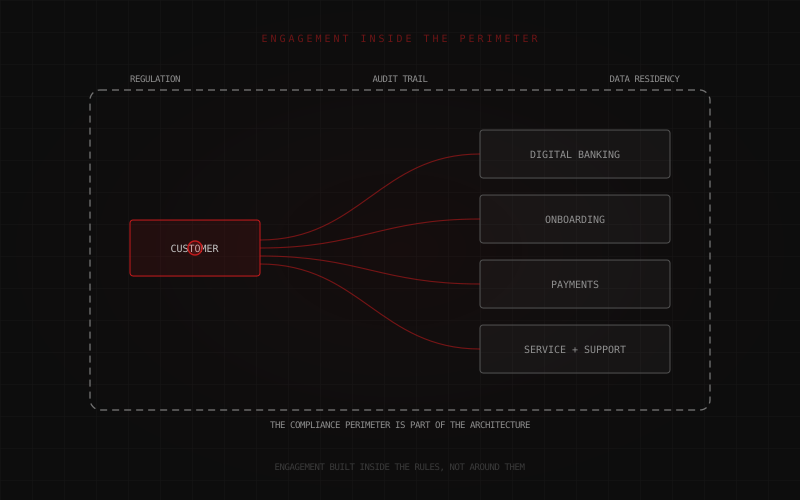
Engagement built inside the rules, not around them. The compliance perimeter is part of the architecture from the first design decision.
The technology challenge in financial services is not a shortage of platforms. It is that most available platforms were not built to operate inside the specific regulatory and operational architecture that Indian and regional financial institutions face. DAM's technology work is organized around three areas where proprietary capability produces durable commercial advantage.
Fintech Product Development
For financial institutions launching digital products consumer lending applications, digital investment platforms, insurance self-service portals, or embedded finance integrations the architecture must be designed around both the customer experience and the regulatory data trail from the first line of code. full-cycle product engineering covering credit workflow logic, KYC and AML data architecture, regulatory reporting integrations, and API layers for partner ecosystems.
Loan origination, insurance policy issuance, and investment account opening are commercial transactions with compliance architecture embedded in each step. Building a digital acquisition platform for a financial product requires the document verification workflow, credit bureau integration, consent management architecture, compliance-approved communication layer, and post-acquisition communication infrastructure to all work as a single governed system.
Insurance Technology and Wealth Management Systems
Policy administration, claims processing, advisor productivity tools, portfolio management platforms, and distributor management systems represent the operational technology layer that determines how efficiently the institution can serve its customers. When this layer is fragmented or underbuilt, the cost shows up in processing delays, advisor attrition, and customer experience scores.
Financial institutions generating decisions that affect customers are subject to auditability requirements that shape the data architecture of any system involved in those decisions. DAM builds software for financial services organizations with the audit trail, access control, and data governance requirements built into the architecture from the start, not configured retrospectively after a compliance review identifies the gap.
Marketing a financial product operates under constraints that most digital agencies have not been designed to manage. The communication must be accurate, not misleading, compliant with the regulatory framework governing the product category, and approved through the internal compliance process before it reaches the customer. DAM's marketing work is built around the premise that regulatory compliance and commercial effectiveness are not opposing objectives.
Regulated Digital Acquisition
Paid acquisition for financial products across search, social, and programmatic channels requires both performance marketing expertise to generate cost-effective lead volume and the regulatory knowledge to ensure what is being advertised in what terms, to which audiences is compliant with the applicable SEBI, RBI, or IRDAI framework. Structured as a design requirement, not a post-campaign filter.
Institutional and high-net-worth financial product marketing requires a different acquisition approach than consumer financial product marketing. The audience is smaller, the decision cycle is longer, the relationship context matters more, and the channels that drive qualified engagement are not the same as those that generate consumer volume. DAM designs lead generation programs for financial services organizations at both market segments.
For organizations that sell through intermediary networks, marketing to the advisor or distributor is as important as marketing to the end customer. Product training materials, practice-building support, co-branded marketing assets, and the digital tools advisors use to communicate with their own clients all represent a marketing investment that compounds through the distribution channel.
Financial institutions that built their brand on branch presence, relationship managers, and institutional reputation are increasingly competing for customers who formed their expectations of financial services through digital channels. Brand repositioning that retains institutional trust signals while building credibility in digital contexts requires a strategy different from either a straight digital rebrand or a defense of the existing positioning.
Financial services events are commercial and relationship programs, not hospitality exercises. Investor conferences, advisor summits, distributor training programs, and product launch events all exist within a framework of regulatory obligation and within a commercial framework of relationship advancement, distribution motivation, and product commitment. Both dimensions must be designed for, not managed reactively.
Investor Conferences and Roadshows
For asset management firms, insurance organizations, and publicly listed financial institutions, investor events are material communication exercises. The agenda design, speaker preparation, information disclosure discipline, and post-event communication all carry regulatory implications. DAM designs and delivers investor-facing events with the documentation and governance discipline that the institutional audience and regulatory environment require.
The annual advisor conference for a major insurance company or mutual fund house is one of the most significant distribution investments the organization makes. The return is determined not by production quality but by whether the program design advances the commercial objective: product knowledge, sales motivation, relationship commitment, and distributor retention. DAM designs advisor conferences around the commercial output.
Launching a new financial product a new fund, an insurance product variant, a structured offering to a distributor or investor audience requires that the audience leaves with a clear understanding of the product rationale, the target customer, and the commercial opportunity, within the bounds of what the regulatory framework permits for that product category. DAM structures product launch events around the communication architecture.
For financial services organizations running large field forces insurance companies with thousands of agents, banks with regional distribution teams leadership conferences are the primary mechanism for culture alignment, strategic communication, and performance motivation. DAM's events practice designs financial services leadership conferences around the behavioral outcomes the commercial leadership is trying to produce.
How DAM Works With Financial Services Organizations
The engagement model for financial services is shaped by the reality that financial institutions carry risk at multiple levels: regulatory risk from non-compliant programs, operational risk from systems that fail under transaction volume, and reputational risk from customer experience failures. A partner that understands only one of those dimensions is not adequately positioned to advise on the others.
01
Compliance Architecture Before Program Design
The applicable regulatory framework is mapped before any program design begins: RBI, SEBI, or IRDAI requirements are a design input, not a review that happens after the program is built.
02
Business Outcome Accountability
Every engagement is governed against a defined commercial outcome: acquisition cost, conversion rate, platform adoption, or event-sourced pipeline, with shared accountability for the result.
03
Integrated Delivery Across Programs
Technology, marketing, and events run as one governed program: the acquisition platform, the campaigns that fill it, and the advisor events that convert relationships are designed against the same brief.
PROGRAM OUTCOMES
Financial Services Program Outcomes
81%
Digital Onboarding Completion
A private sector bank's digital savings account onboarding completion rate improved from 54% to 81% within two months of platform relaunch. The documentation error rate triggering manual reviews fell by 67%.
A life insurance distribution organization with over 2,000 independent financial advisors saw advisor active selling time increase by an average of 34%, and the policy renewal rate across the network improved by 22 percentage points in the first full cycle after a custom advisor productivity platform deployment.
A general insurance organization's lead conversion rate lifted from 6.1% to 11.4% within three months of a regulated digital acquisition program redesign, while reducing the cost per submitted application by 28%.
An asset management firm's institutional investor conference generated INR 47 crore in documented pipeline conversations within 45 days of the event close, with seven active allocator relationships that had not existed before the program.
Regulatory requirements are treated as architecture inputs, not post-build constraints. Before any financial services technology engagement enters design, the applicable regulatory framework RBI digital lending guidelines, SEBI communication requirements for investment products, IRDAI parameters for insurance platforms, data localization obligations is mapped and documented. The architecture decisions around data storage, access control, audit trails, customer communication records, and KYC workflow are made with those requirements as binding constraints, not considerations to address in a compliance review after the system is built. This approach eliminates the rework cycle that results from treating compliance as a late-stage gate and produces a system whose compliance posture is defensible by design rather than by configuration.
Yes. DAM's financial services technology and marketing work has been delivered within the regulatory frameworks governing securities, banking, and insurance products in India. This includes building digital lending platforms within the RBI's digital lending guidelines, designing investment product marketing programs within SEBI's advertising code for collective investment schemes, and structuring insurance marketing and distribution programs within IRDAI's applicable regulations. The team working on a financial services engagement includes members with direct prior experience in these frameworks, not only in adjacent regulated industries. This is relevant because the frameworks differ materially from each other and from pharma or healthcare regulation, and the specific requirements for data, communication, and audit in each must be understood directly, not approximated from a general regulated-industry model.
The marketing compliance architecture is built before the campaign brief is written. This means the audience targeting parameters, the communication claims that can and cannot be made about the product, the disclaimer and risk disclosure requirements, the channel-specific restrictions, and the internal approval workflow are all defined and agreed with the client's compliance team before any creative or media planning work begins. The program design then operates within those parameters as fixed constraints rather than variables to be managed reactively. For organizations with an existing marketing compliance framework, DAM works within it. For organizations that need help structuring a compliant financial product marketing framework, that design work is part of the engagement scope.
The engagement model differs because the starting position differs significantly. A fintech organization building a product for the first time needs an architecture and compliance design that anticipates the regulatory obligations it will face as it scales, and a commercial design that generates adoption in a competitive digital market from a standing start. An incumbent financial institution modernizing an existing product or launching a new channel needs an approach that accounts for the existing customer base, the legacy system constraints, the internal approval and governance architecture, and the distribution network whose behavior needs to change as part of the program. The commercial outcomes being pursued customer acquisition, AUM growth, policy activation, distributor productivity are often similar, but the path to them and the constraints along it are structurally different. DAM has worked across both contexts and structures the engagement accordingly.
Financial services technology programs at DAM are built to the data security standards applicable to the institution's regulatory classification, plus the organization's own internal data governance requirements. In practice, this means data residency compliance with RBI or SEBI requirements where applicable, access control architecture designed around the principle of least privilege, audit trail coverage for every data state that could be subject to regulatory review, encryption standards appropriate to the sensitivity of the financial data being processed, and penetration testing before any customer-facing system goes live. The specific requirements are documented during the engagement scoping phase and reviewed with the client's information security team before architecture decisions are finalized. For organizations managing customer financial data at scale, the security design is not a feature of the system. It is a foundational requirement of the architecture, and it is treated accordingly from the first design session.
START THE CONVERSATION
Bring Your Financial Services Commercial Challenge to DAM
Financial services organizations managing the most significant commercial programs a new digital product launch, a distribution network modernization, a brand repositioning for a new customer segment, or an investor or advisor conference that has to produce commercial outcomes need a partner who understands the operating environment before they understand the brief. The conversation does not start with a service catalog. It starts with the commercial challenge the organization is facing, the regulatory constraints that shape the solution space, and what success looks like in measurable terms for the business.
We use cookies to improve this site.We use cookies to understand how the site is used and to improve it. You can accept all cookies or continue with only what is needed. See our Privacy Policy.