

Growth Marketing

When the Pipeline Gap Keeps Widening, the Problem Is Usually in How the Marketing Program Was Designed

Revenue targets do not move, but the pipeline that is supposed to feed them often does not keep pace. Marketing spend goes up, the activity reports get longer, and the gap between what marketing is producing and what the sales organization needs to close its number stays stubbornly in place.

Pharma and Healthcare HCP engagement, MLR-compliant programs, field force

Manufacturing B2B pipeline programs, account-based demand generation

Financial Services digital acquisition, retention and cross-sell programs

Real Estate launch campaign architecture, channel partner marketing

The Problem

Where Marketing Investment Goes Wrong at Enterprise Scale

The most common version of enterprise marketing spend is a portfolio of channel programs, each managed by a specialist team or agency, each measured against its own KPI set, and none of them formally accountable to a pipeline or revenue number.

The SEO agency reports on rankings and organic traffic. The paid media team reports on impressions, clicks, and cost-per-click. The social team reports on follower growth and engagement rates. The content team reports on downloads and email subscribers. Separately, each report looks reasonable. Together, they do not explain why the sales pipeline is 30 percent below what the revenue plan requires.

The problem is structural. When each channel is budgeted and measured independently, the organization is optimizing for channel performance, not commercial performance. The channels that are hardest to attribute directly to revenue get cut in budget cycles because they cannot defend themselves with a pipeline number. The channels easiest to attribute get over-invested at the expense of the brand equity that makes paid acquisition sustainable. The compounding effect that happens when brand, demand, and experience reinforce each other never materializes, because each program is running its own race.

For enterprise organizations with multiple product lines, multiple markets, or both, this problem multiplies. Each business unit has its own marketing budget, its own set of agencies, and its own reporting cadence. The CMO is managing a portfolio of channel vendors with no unified view of what the combined investment is producing commercially.

Growth marketing at the enterprise scale requires a design approach that starts with the commercial objective and works backward to determine which combination of programs, at what investment level, will produce the required pipeline and revenue outcomes within the required time horizon. The channel mix is an output of that design, not the starting point.

Our Approach

Growth Marketing Built Around Commercial Targets

Growth marketing, as DAM Networks practices it, begins with a commercial question, not a channel inventory.

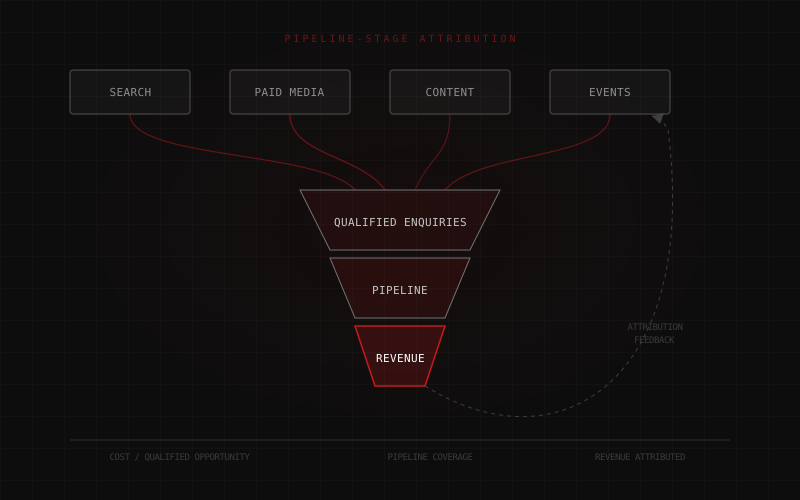
The commercial question is specific: what pipeline volume does this organization need to generate, at what cost per qualified opportunity, to give the sales team a realistic chance of closing its revenue target this year? That question defines the scope of the marketing program. The channel mix, the content investment, the paid media budget, and the brand program are all sized and sequenced to answer it.

This approach produces three differences in how programs are designed and managed.

What gets measured

When the program is designed against a commercial target, the reporting structure changes. Channel metrics are still tracked, but they are tracked as leading indicators, not as outcomes. The outcome is pipeline contribution, cost per acquisition, and revenue attributed to marketing. Those numbers are visible to the CMO, the CFO, and the sales leadership team.

How budget is allocated

When every program element is evaluated against its commercial contribution, budget decisions are made against the same criteria. A brand investment that demonstrably reduces paid acquisition cost over time is defensible in a budget review. A paid media program that is generating clicks but producing no qualified pipeline is not, regardless of how strong the channel-level metrics look.

How sales and marketing align

When both functions work against the same commercial definition of a qualified opportunity the same stage-gate criteria, the same revenue attribution model the monthly argument about lead quality either disappears or becomes a productive diagnostic conversation rather than a blame cycle.

Data and analytics capability is foundational to this approach. Attribution clarity, funnel visibility, and the ability to connect marketing activity to pipeline stage and revenue outcome require a data architecture that most organizations are still building. DAM works alongside the client's revenue operations function, or stands it up where it does not yet exist, to make commercial accountability in marketing a structural capability rather than a quarterly aspiration.

Capabilities

Three Capability Areas, One Commercial Program

Described separately because the work in each area is distinct. In practice, they run as components of one commercial program, designed against the same revenue target, measured against the same pipeline contribution model.

Performance Marketing

Paid acquisition and demand generation programs designed to put qualified opportunities into the pipeline at a defined cost per acquisition. This includes paid search (PPC management), paid social, programmatic, and account-based demand generation. The design of these programs is governed by the commercial target, not by platform capability.

SEO and Content

SEO and content programs at the enterprise level are long-duration commercial investments, not traffic generation exercises. An organization that owns the highest-quality organic positions for the searches its buyers conduct has a structural cost-per-acquisition advantage. The compounding nature of that advantage means SEO investment produces a different return profile than paid acquisition.

Engagement Model

How DAM Builds a Growth Marketing Engagement

Every growth marketing engagement begins with a commercial brief, not a channel audit.

01

Commercial Brief

Define the revenue target, pipeline volume required at current conversion rates, current state of the marketing-to-pipeline contribution model, and the gap that the marketing program needs to close.

02

Program Architecture

Design which capability areas are required, in what sequence, at what investment level, and with what timeline to measurable commercial impact. This is the business case for the marketing program, built before any channel is selected.

03

Commercial KPI Framework

Set program-level KPIs: pipeline contribution by quarter, cost per qualified opportunity, lead-to-opportunity conversion rate by source, and revenue directly attributed to marketing programs. Channel-level metrics are tracked as diagnostics, not outcomes.

04

Governed Execution

DAM's performance marketing, SEO, content, and brand teams work against the same commercial objective, with shared reporting and a unified view of how each element is contributing to the pipeline target.

Industries

Growth Marketing Across Four Industries

Growth marketing challenges are industry-specific in ways that generic agency programs do not account for. The commercial model, the regulatory environment, the buyer behavior, and the sales cycle in pharma are structurally different from those in manufacturing, financial services, or real estate.

Pharmaceutical and Healthcare

In pharmaceutical commercial marketing, the constraint is the regulatory review process. A paid media campaign or digital outreach program that does not survive medical-legal-regulatory review on time does not generate pipeline, regardless of how well it was designed. Growth marketing programs for pharma must be designed with regulatory compliance as a structural element clear messaging hierarchies, content workflows that account for review cycles, and channel selection based on what the organization can execute within its compliance function's bandwidth.

Pharma and Healthcare practice →

Manufacturing

B2B manufacturers face a growth marketing challenge that is primarily a pipeline problem. Sales cycles are long, deal sizes are significant, the number of qualified buyers in any given market segment is finite, and the existing customer base is underserved by most marketing programs. The growth marketing program focuses on account-level pipeline: who are the accounts most likely to buy and what combination of content, events, digital outreach, and sales enablement will move the most accounts through the pipeline at the required rate.

Manufacturing practice →

Financial Services

Financial services marketing operates at the intersection of brand trust, regulatory disclosure requirements, and increasingly competitive digital acquisition. Organizations seeing improving cost efficiency have built strong brand positions that reduce friction in paid acquisition. Growth marketing in financial services also requires a view of the full customer lifecycle retention and cross-sell programs that extend the commercial relationship are almost always higher-return than acquiring a replacement customer.

Financial Services practice →

Real Estate

Property developers and real estate organizations have a marketing challenge defined by launch cycles and inventory absorption rates. Growth marketing for real estate is organized around launch campaign architecture digital advertising, channel partner engagement, content, and reputation programs that determine how many qualified inquiries a project generates before, during, and after the public launch phase.

Real Estate practice →

Program Outcomes

Program Outcomes

From DAM growth marketing engagements. Each represents a different industry, a different commercial challenge, and a different primary performance lever.

44% reduction in cost per qualified lead pipeline coverage from 1.8x to 2.6x

B2B technology firm. Account-based targeting, tighter MQL qualification criteria, and a content-to-pipeline sequence for mid-funnel prospects drove the result over two quarters.

Read more in our case studies →

3.1x increase in HCP-initiated product inquiries before public launch

Pharmaceutical company launching a specialist product. MLR-compliant content and digital outreach organized around specialist HCP audiences produced a measurable commercial signal in the pre-launch window.

Read more in our case studies →

67% lower cost per qualified lead from organic vs paid 2.4x previous lead volume

Mid-size industrial manufacturer. 12-month enterprise SEO and content program targeting primary buyer persona search behavior. Organic search became the highest-volume qualified lead source within 18 months.

Read more in our case studies →

38% improvement in lead-to-booking conversion for residential developer

Channel partner marketing platform and supporting content program. Developer gained real-time pipeline visibility across its full channel network for the first time, alongside the conversion rate improvement.

Read more in our case studies →

Start Here

Start With the Revenue Objective

Growth marketing programs that produce commercial accountability start with a different conversation. The right starting point is not what channels to run. It is what the business needs to produce in revenue this year, what pipeline volume is required to get there at current conversion rates, and what the gap is between what the current marketing program is delivering and what it needs to deliver.

FAQ

Frequently Asked Questions

How is growth marketing different from traditional marketing?

Traditional marketing is typically organized by channel: a social team, a content team, a paid media team, each with its own budget and KPIs. Growth marketing is organized by commercial outcome. The program is designed against a pipeline and revenue target, and channel selection is a consequence of that design, not the starting point. The distinction shows up most clearly in how performance is reported: channel metrics versus commercial contribution.

What does DAM Networks actually measure in a growth marketing engagement?

The primary commercial metrics are pipeline contribution by quarter, cost per qualified opportunity by source, lead-to-opportunity conversion rate, and revenue directly attributed to marketing programs. Channel-level metrics impressions, clicks, rankings, open rates are tracked as leading indicators and diagnostics, not as outcomes. The reporting the client receives is organized around commercial performance, not activity volume.

How long before a growth marketing program produces measurable pipeline results?

The timeline depends on the channel mix and the program design. Performance marketing programs built around paid acquisition can produce pipeline contribution within four to six weeks of launch. SEO and content programs produce compounding returns over a longer horizon meaningful pipeline contribution typically becomes visible within nine to twelve months, with the return profile improving through the second and third year. A program designed against commercial targets sequences these investments to produce near-term pipeline impact while building the organic capability that reduces acquisition cost over time.

Can DAM Networks manage growth marketing for organizations in regulated industries?

Yes. DAM has specific experience designing and managing marketing programs within the regulatory constraints of pharmaceutical and financial services environments. For pharma clients, this means content workflows that account for medical-legal-regulatory review cycles and program timelines built around those constraints. For financial services clients, it means messaging and disclosure architectures that allow effective marketing while meeting regulatory communication requirements. Regulatory compliance is treated as a program design parameter, not a post-production review.

How does growth marketing connect to the rest of an organization's commercial operations?

Growth marketing produces qualified pipeline. The quality and volume of that pipeline directly affects the productivity of the sales organization. When the two functions share a common commercial definition of a qualified opportunity and a unified attribution model, the marketing program can be managed in direct response to what the sales team needs. DAM works with both marketing and sales leadership to establish that shared framework at the start of an engagement. For organizations where digital transformation is also underway, the CRM, marketing automation, and analytics infrastructure decisions that affect the pipeline model are aligned with the marketing program design from the beginning.

What is the minimum scale of organization DAM Networks works with for growth marketing?

DAM works with enterprise and mid-market organizations, typically from 200 employees upward, where a structured growth marketing engagement produces a commercial return that justifies the program investment. The right fit is an organization where the marketing function is accountable to a revenue or pipeline target and where the gap between current performance and required performance is material enough to warrant a structured program rather than channel-level optimization.

How does DAM's growth marketing practice relate to its other capabilities?

Growth marketing does not operate in isolation. The pipeline a marketing program produces is only as valuable as the sales process, customer experience, and technology infrastructure it feeds into. For organizations running enterprise technology programs, the marketing architecture is designed to work with the CRM and data infrastructure being built. For organizations focused on customer experience improvement, the conversion performance downstream of the marketing program is treated as part of the commercial outcome. DAM's ability to work across these capability areas within a single engagement model means growth marketing programs are designed against the full commercial system, not just the lead generation layer of it.