

Enterprise Digital Transformation That Produces Business Results, Not IT Roadmaps
DAM Networks digital transformation services are built around the business outcome, not the technology specification. The outcome is defined before a single technology decision is made.
The Problem With Most Transformation Programs
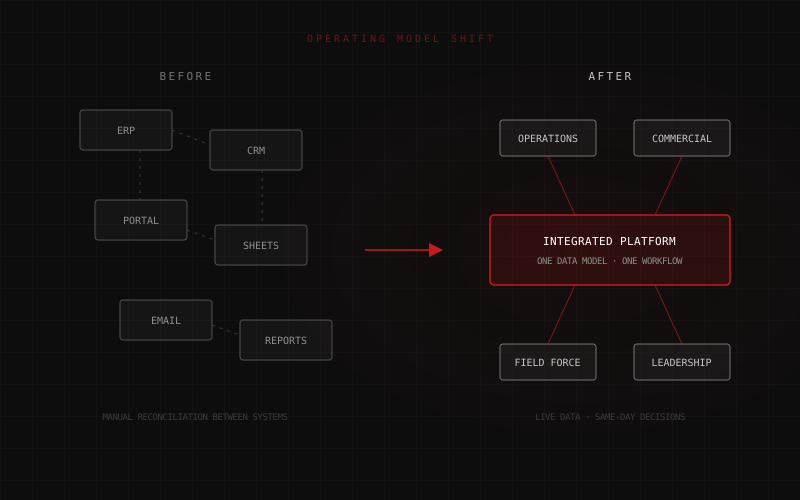
Most transformation programs begin with a technology selection and declare success at go-live. Eighteen months later the organization has a new system running on top of the same broken processes, with adoption far below the ROI model assumption.
The root cause is almost always IT-business misalignment, process debt, or vendor sprawl. The organizations that avoid this treat the business outcome as the design constraint, not the deliverable.
What Enterprise Transformation Actually Requires
Before any architecture decision or vendor evaluation, the engagement must answer three questions: what business capability is broken, what does success look like in measurable terms, and who in the business owns the outcome once the program closes.
When business outcome definition precedes technology selection, the technology choices are constrained by what the business actually needs. DAM Networks partners hold the business outcome accountable through every phase of the program, including the phases where the business itself needs to change how it operates.
The Challenges We Are Built For
The business and IT teams are solving different problems.
A transformation program owned by IT will optimize for implementation quality. A program owned by the business will optimize for speed. Neither orientation produces results without the other. We structure engagements so that business outcome accountability and technical delivery are governed as a single program, not two parallel workstreams reporting to the same steering committee.
The existing process was never designed for current scale.
What worked at 500 employees and three product lines becomes a constraint at 5,000 employees and fifteen. The workflows, approvals, and data flows built during an earlier phase of growth now create the friction that slows decisions, delays launches, and increases operational cost. Automating those workflows without first redesigning them produces faster friction, not less.
The organization has accumulated a portfolio of point solutions with no coherent architecture.
Each department solved its own problem with the tool available at the time. The result is a technology estate that contains real capability but delivers well below its potential because the systems do not share data, workflows terminate at system boundaries, and no single view of the business actually exists.
Compliance requirements are slowing down, not protecting, the business.
This is a particular reality in pharma, financial services, and healthcare. Regulatory constraints are treated as a reason not to modernize rather than a parameter within which modernization must occur. The right program design builds compliance posture into the architecture from the start, not around it after the fact.
The last transformation program did not deliver what the business case promised.
The appetite for another multi-year initiative with uncertain returns is low. We work with organizations to scope programs that produce measurable outcomes within defined time horizons, with clear accountability for what changes if the milestones are not met.
The workforce is not ready to operate in the new model.
Technology deployment without behavioral change produces shelfware. The change management dimension of a transformation program is not a communications plan issued after go-live. It is a structured program that runs in parallel with delivery, with adoption metrics treated with the same seriousness as technical delivery milestones.
What We Do Within Digital Transformation
Digital transformation is not a single service. It moves through distinct phases, each requiring a different kind of work. The three capabilities within DAM's Digital Transformation practice address different phases of the same problem.
Business Process Automation
Addresses the operational layer. Identifying where manual, fragmented, or duplicated processes are consuming cost and cycle time, then redesigning and automating them at enterprise scale. This includes enterprise automation of cross-functional workflows where the volume and complexity of transactions have outgrown manual management.
Explore Business Process Automation →Digital Consulting
The strategy and architecture layer. Before committing to a transformation program, an organization needs an honest assessment of its current capability, a clear definition of its target operating model, and a sequenced roadmap that accounts for budget, risk, and organizational change capacity.
Explore Digital Consulting →Enterprise Modernization
The delivery layer for organizations whose core systems, applications, or infrastructure are limiting the pace of change. Legacy systems are not just a technology liability. Modernization removes that constraint in a way that protects continuity, meets compliance requirements, and produces a technology estate the organization can build on.
Explore Enterprise Modernization →Ready to discuss your transformation priorities?
Talk to Our TeamHow We Approach a Transformation Engagement
Scoped Discovery
Every engagement begins with a structured discovery process designed to surface the actual business problem, not the problem as described in the original RFP. We interview business and technology stakeholders separately, map the current process and system state, and pressure-test the assumptions usually embedded in the program brief. The output is a problem definition the business and IT teams agree on, which is the precondition for everything else.
Integrated Recommendation
The recommendation is not a technology selection. It is a business transformation design that includes the target operating model, the sequenced program plan, the change management architecture, and a business case built around outcome metrics the program will be held to. All of this is presented before any commitment is made to delivery.
Delivery With Shared Accountability
Delivery is structured in defined phases with milestone-based outcome checkpoints. The program is not managed to budget alone. It is managed to the outcome metrics agreed in Step 2. If a milestone is missed, we identify the cause within the delivery structure before adding scope or time.
Performance Review
At defined intervals after go-live, we conduct a structured performance review measuring actual outcomes against the business case. This is not a customer satisfaction survey. It is an honest assessment of what changed in the business, what did not, and what the next phase of the program should address.
Industries We Transform
Pharma and Healthcare
Pharmaceutical organizations face a transformation challenge that is structurally different from most other industries. The regulatory environment constrains what can be communicated, to whom, and through which channels. DAM Networks works with pharmaceutical companies across the full transformation agenda: sales force automation, HCP engagement platforms, regulatory-compliant digital programs, and medical conference execution.
See our Pharma and Healthcare practice →Manufacturing
Manufacturers are navigating the gap between plant-floor operational technology and enterprise IT. The priority challenges are real-time production visibility, dealer and distributor portal modernization, B2B commerce digitization, and supply chain data integration.
See our Manufacturing practice →Financial Services
Financial services organizations are managing competing transformation priorities: core system modernization, digital customer acquisition, regulatory compliance architecture, and the structural shift from branch-based to channel-agnostic service delivery.
See our Financial Services practice →Real Estate
Real estate organizations are digitizing the full customer lifecycle, from lead generation and project launches through channel partner management and post-sale engagement. The transformation priorities are CRM adoption, digital marketing infrastructure, property portal modernization, and channel partner enablement at scale.
See our Real Estate practice →Ecommerce and Retail
Retail and D2C organizations are digitizing the full commerce stack, from platform architecture and marketplace integration through performance marketing and customer data infrastructure.
See our Ecommerce and Retail practice →Logistics and Supply Chain
Many logistics organizations run commercial and digital infrastructure on systems that no longer match the expectations of customers and partners. DAM addresses customer portals, supply chain analytics, and commercial platforms.
See our Logistics and Supply Chain practice →Education and Learning
EdTech and enterprise learning programs face transformation at the intersection of product infrastructure, learner experience, and adoption. The priority is building the data and delivery infrastructure that makes learning outcomes measurable.
See our Education and Learning practice →Results That Matter
42% reduction in order processing cycle time
A manufacturing organization with multi-plant operations had accumulated a fragmented order management process across three systems that could not communicate reliably. After a process redesign and integration program, order-to-confirmation time dropped from 11 days to under 6.5 days, with a direct impact on dealer satisfaction scores and repeat order rates.
Read the case study →68% improvement in HCP digital engagement rates
A specialty pharma client had invested in a digital engagement platform generating less than 15 percent adoption among its field force and near-zero sustained HCP engagement. We redesigned the content strategy, rebuilt the field force enablement program, and connected the digital platform to the company's national sales conference agenda. Within two cycles, HCP engagement rates moved from 14 percent to over 82 percent.
INR 3.2 crore in annual operational savings
A financial services organization was processing over 4,000 manual transactions per month across loan origination, documentation, and disbursement workflows. After a process intelligence assessment and automation program, 73 percent of those transactions were automated, reducing per-transaction cost by 61 percent and eliminating the documentation error rate generating downstream compliance remediation costs.
Read the case study →3x increase in project launch velocity
A real estate developer was running property launches on a six-to-eight week lead time with significant manual coordination between their marketing agency, channel partners, and internal sales team. After rebuilding their launch infrastructure around an integrated CRM, digital marketing stack, and channel partner portal, the same launch now runs in under three weeks with 40 percent higher lead-to-site-visit conversion.
Read the case study →Start With the Business Problem
The organizations that get the most from a transformation program come in with a business problem, not a technology specification. Whatever the context, the conversation starts in the same place: what does success look like for your business in twelve to twenty-four months, and what is currently in the way of that.
Frequently Asked Questions
What is the difference between digital transformation consulting and IT consulting?
IT consulting focuses on technology selection, implementation, and infrastructure. Digital transformation consulting starts with the business outcome the organization is trying to reach and works backward to identify what combination of process change, technology, organizational design, and capability building is required to get there. The scope of the problem is different, and so is the accountability model.
How long does an enterprise digital transformation engagement typically take?
Scope varies significantly by program. A process automation engagement focused on a single business unit might produce measurable outcomes in twelve to sixteen weeks. A full enterprise modernization program covering core system migration, process redesign, and change management will typically run eighteen to thirty-six months. We scope programs in phases so that each phase has a defined outcome and a decision point before the next phase begins.
How does DAM Networks define transformation ROI?
We define ROI in operational and commercial terms before the program starts: cost per transaction, cycle time, adoption rate, revenue per customer, lead-to-conversion rate, or compliance incident rate, depending on the business problem. These become the program's success metrics, not implementation completion. The business case is built around these numbers, and the program is tracked against them throughout delivery.
What industries does DAM Networks specialize in for digital transformation?
Our primary industry depth is in Pharma and Healthcare, Manufacturing, Financial Services, and Real Estate. Within pharma in particular, we have specific capability across regulatory-compliant digital programs, HCP engagement platforms, sales force automation, and medical event compliance. Our industry pages provide program-specific detail for each sector.
Does DAM Networks work with organizations that have already started a transformation program?
Yes. Many engagements begin with a program recovery assessment. We evaluate what has been built, where the program has deviated from its business case, and what the fastest path to measurable outcome looks like from the current position. This is often a shorter and more productive starting point than beginning from scratch.
What makes DAM Networks different from a large system integrator?
Large system integrators bring deep technical delivery capability and platform expertise. The gap they typically leave is on the business design, change management, commercial, and experience side of transformation. DAM Networks combines technology delivery with growth marketing, customer experience design, and events and experiences within a single engagement structure. For organizations where adoption and commercial performance are as important as technical delivery, this combination produces outcomes that a technology-only program does not.
Can DAM Networks support transformation programs across multiple geographies?
Yes. DAM Networks delivers transformation programs for organizations operating across multiple geographies, with active engagements spanning India, Southeast Asia, and the Middle East. Our delivery structure accounts for cross-border program governance, time zone distribution across core workstreams, and the regulatory and market differences that affect how transformation programs must be sequenced in each location.
Ready to define your transformation program?
Talk to Our TeamRelated Insights