
When Your Operations Outgrow the Platforms Everyone Else Is Using
DAM Networks delivers enterprise technology solutions for organizations that have reached the point where standard platforms impose a structural ceiling on how fast and how well the business operates. We build proprietary technology capability designed around your commercial model not the market average.
Technology Built Around Your Competitive Advantage, Not the Market Average
Every commercial platform is designed for the median use case. For enterprises with differentiated workflows, complex commercial models, or regulatory constraints, that gap becomes a structural ceiling on how fast the business can operate.
DAM Networks works with organizations that have reached this point: those that need technology built around how they actually operate, not how a platform assumes they should.
The Gap Between What Platforms Offer and What Your Business Actually Requires
Your workflow does not match the default model, and the configuration required to close the gap creates technical debt faster than value.
Every workaround, every custom field, every process forced into a structure it was not designed for becomes a liability the next time the platform releases a major update or the team needs to change how it works.
Critical business data lives across systems that do not share it reliably.
The CRM does not talk to the ERP. The sales data does not flow into the reporting environment without manual intervention. Decisions that require a complete view of the business are made with an incomplete one, or delayed until someone runs a report.
The product or service your organization wants to launch requires a capability the platform does not support.
The commercial opportunity is there. The technology constraint is what is preventing you from moving. And the answer your current vendor gives is to wait for the roadmap or find a third-party add-on that introduces its own integration complexity.
You are paying platform licensing costs for capability you do not use, and paying for critical capability that is missing.
The economic model of broad-coverage platforms means the pricing is weighted toward features your organization does not need, while the things that would genuinely change your operations are either not present or locked behind an enterprise tier with a long implementation cycle.
Your technology vendor's roadmap is not aligned with your competitive situation.
The vendor's priorities are set by their aggregate customer base. Your market timing, your regulatory requirements, or your commercial model may require capabilities on a timeline that does not match where the platform is heading.
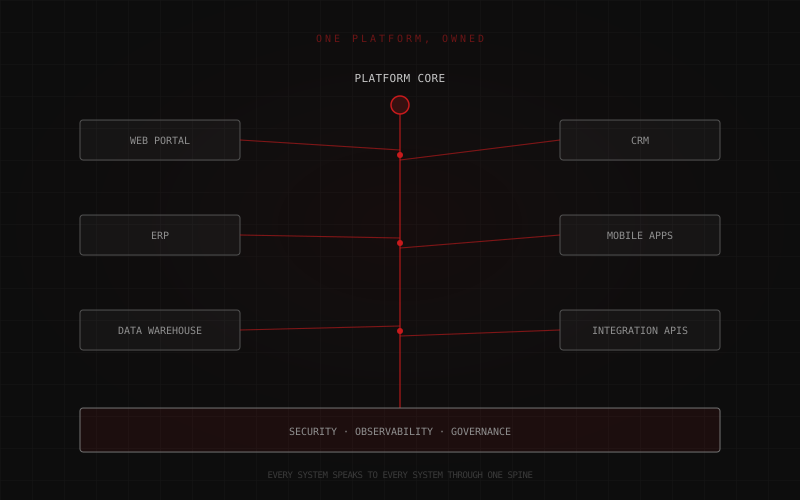
Integration complexity has become a full-time operational problem.
The effort required to maintain connections between systems, manage data quality across those connections, and handle failure states has grown to the point where a meaningful share of the technology team's capacity is consumed by keeping the current architecture functional rather than improving it.
How DAM Approaches an Enterprise Technology Engagement
Business Diagnostic
The starting point is not a technology stack decision. It is a precise definition of the business problem the technology is intended to solve requiring understanding of the commercial model, operational constraints, data environment, and competitive context. This diagnostic identifies where technology capability is limiting the business and what the right architecture looks like for the specific situation. It is structurally aligned with our digital transformation practice, focused entirely on the technology capability question.
Architecture and Scope Definition
The output of the diagnostic is a recommendation addressing build scope, integration requirements, data architecture, and the governance model for what gets built. Scope is defined in terms of capability and outcome additions to scope are evaluated against the business case, not added because they are technically interesting.
Outcome-Milestone Delivery
Delivery is organized around defined outcome milestones, not implementation phases. A delivery milestone asks whether the business can do something it could not do before, and by how much that matters in operational or commercial terms. We govern against the former, not against whether the technical work is complete.
Transition and Ownership
Architecture decisions, documentation standards, and knowledge transfer workstreams built into the program ensure the organization's team can operate and extend the system independently. The organization leaves the engagement with a capability it can run and build on, not a dependency on the team that built it.
The Technology Capabilities We Build
DAM's enterprise technology practice covers the full range of what complex organizations need to build proprietary capability.
Product and Application Development
Custom Software Development
For organizations that need a capability that does not exist in the commercial market or that requires a level of specificity standard software cannot deliver. Begins with the business logic and builds to a technical architecture that supports it.
Web Application Development
Operational and commercial interfaces on the web internal platforms, dealer and partner portals, customer-facing tools, and any workflow that requires browser-based access at enterprise scale.
Mobile App Development
Field-force tools, customer applications, and operational interfaces for mobile including offline capability, device management, and the security requirements enterprise environments impose.
Product Development
Full lifecycle from product definition through architecture, build, and launch for organizations developing a software product as part of their commercial model. For organizations turning internal expertise into a marketable product.
AI and Infrastructure
Artificial Intelligence
Enterprise AI from use-case definition through model development, integration, and production deployment. Governed by business outcome a specific decision that improves, a process that moves faster, a cost that falls by a defined amount.
Cloud Consulting
Infrastructure for organizations moving workloads to cloud environments, modernizing hosting architecture, or building cloud-native applications that need to scale. Infrastructure decisions affect the cost, performance, and security of everything built on top.
DevOps Consulting
Delivery velocity and reliability architecture for enterprise programs. Deployment pipelines, testing automation, and the governance model for how software moves from development into production.
Delivery Capacity
Team Augmentation
Extends the engineering capacity available to an enterprise program without the recruitment, onboarding, and management overhead of permanent hiring. For programs with defined delivery horizons or specialist capability requirements.
Ready to discuss your technology program?
Talk to Our TeamThe Sectors Where We Build Technology That Performs Under Real Conditions
Pharma and Healthcare
Pharma commercial operations depend on data from hundreds of territories across field force, sample inventory, and HCP engagement. DAM builds the platforms that consolidate and surface this data, giving commercial leadership a reliable, integrated view in real time.
View pharma and healthcare practiceManufacturing
The gap between plant-floor systems and enterprise platforms is one of the most persistent technology problems in manufacturing. DAM builds the integration layers and enterprise applications that connect these environments and surface data where decisions are made.
View manufacturing practiceFinancial Services
Custom application architecture lets financial services teams move at market speed without creating audit exposure. DAM builds applications and data platforms that let organizations ship product capability faster while maintaining compliance integrity.
View financial services practiceReal Estate
Channel partner productivity depends on the quality of tools partners use to access inventory, submit bookings, and track their pipeline. DAM builds the platforms that give developers real-time inventory visibility and structured booking workflows at scale.
View real estate practiceTechnology Investments That Delivered Business Outcomes
52% reduction in data reconciliation time
A pharmaceutical organization with a 300-person field force managed sample tracking, call reporting, and territory performance data across six disconnected tools. A custom field data platform consolidated all six streams, reducing the reporting cycle from 72 hours to under 35 and making territory performance decisions available two business days earlier per cycle.
Review the case studies38% reduction in production exception rate
A mid-size manufacturer with four plants operated each facility on a separate system with no real-time data sharing. A custom integration layer connected all four plant systems to the central ERP, reducing the exception identification-to-resolution cycle from 28 hours to under 8 and cutting the rate of exceptions that escalated into supply chain disruptions by 38%.
Review the case studies61% increase in distributor activation rate
A financial products distribution company reduced its distributor onboarding cycle from 19 business days to four with a purpose-built SaaS onboarding platform. The proportion of registered distributors completing their first transaction within 30 days increased from 66% to 94%.
Review the case studiesThe Decision That Determines What Your Technology Can Do
Bring a current technology constraint or a capability you are planning to build. The conversation starts with your situation, not a service catalog.
Frequently Asked Questions
What is the difference between building custom enterprise software and buying a commercial platform?
A commercial platform is optimized for the broadest set of use cases across its market. It is faster to deploy and lower in initial cost, but it constrains what your organization can do to what the platform's roadmap supports. Custom enterprise software is built around your specific workflows, data model, and commercial requirements. The build cost is higher and the timeline is longer, but the organization owns the capability and is not limited by a vendor's product decisions. The right answer depends on how differentiated your operations are and how much the platform gap is costing you in workarounds, integration complexity, or missed commercial opportunity.
How does DAM handle technical debt in existing systems before building new capability?
Technical debt is addressed as a design input, not a cleanup project. Before any new capability is scoped, we assess the current technology estate to understand which parts are stable enough to build on, which need to be replaced, and which can be worked around safely. We do not recommend a complete replacement when a targeted modernization achieves the business goal. We also do not build new capability on a foundation that will constrain it within 18 months. The assessment determines the sequencing, and the sequencing is explained to the business before any commitment to build.
What happens to the technology after DAM delivers it?
Delivery is structured with operation and ownership in mind from the start. Architecture decisions during build account for how the organization's internal team will maintain and extend the system. Documentation is maintained as a deliverable throughout the engagement, not produced as a final artifact. The knowledge transfer workstream runs in parallel with the later stages of delivery, not after go-live. The intention is that the organization's team can operate and extend the system independently, with DAM available for ongoing development or a defined support period, depending on the engagement model agreed at the outset.
Does DAM work with enterprises that already have an internal technology team?
Yes. Most enterprise technology engagements involve an internal team, and how DAM works with that team is determined during engagement design. In some cases DAM is the primary delivery team with the internal team as governance and review. In others, DAM works alongside the internal team on specific capability areas where outside expertise or capacity is needed. In both cases, the internal team's knowledge of the business is a critical input to the work, not something that is bypassed.
How is the scope of a custom enterprise software engagement determined?
Scope is determined by the business problem, not by a feature list. The first step is understanding what the business needs to be able to do, what the current constraint is, and what measurable change in business performance the technology is expected to produce. From there, the architecture is designed to meet that need with the minimum necessary complexity. Scope is defined in terms of capability and outcome, which means additions to scope are evaluated against the business case, not added because they are technically interesting or because a stakeholder wants them.
How does DAM approach software engagements in regulated industries like pharma or financial services?
Regulatory requirements are a design input, not a late-stage constraint. For industries with specific compliance, auditability, or data governance requirements, those requirements are documented at the start of the engagement and built into the architecture from the first design decision. This includes data residency, access control models, audit trail requirements, and the specific documentation standards the industry demands. Our work in pharma and healthcare and financial services reflects this approach across multiple programs.
At what stage should an organization engage DAM for an enterprise technology program?
The earlier the better, but DAM works at every stage. Organizations that engage before a technology decision has been made get the most from the diagnostic process: the business problem is clearly defined, the architecture options are evaluated against it, and the build scope reflects the actual need. Organizations that have already made a technology decision, started a build, or are managing a system that is not performing as expected can engage for an assessment, a program recovery, or a specific capability extension. The starting point is the current situation, not an ideal starting condition.