CLOUD CONSULTING · MANAGED DEVOPS

Managed DevOps for Enterprise Engineering Teams That Need CI/CD and Infrastructure Automation Without Building the Capability Internally

Internal engineering teams are built to deliver product. Building and operating a DevOps function alongside product delivery stretches the team and produces neither well. DAM Networks provides managed DevOps as a specialist capability — pipeline design, infrastructure automation, and cloud operations run as an ongoing service.

THE PROBLEM

DevOps capability gaps slow delivery, accumulate deployment risk, and cost more to fix retroactively than to build correctly from the start.

Engineering teams at enterprise organisations are focused on product delivery. When DevOps capability sits within the product engineering team, it competes with feature development for the same engineers' time. The result is a CI/CD pipeline that works but has not been reviewed, a deployment process that requires manual intervention at critical steps, and infrastructure that has drifted from its documented specification because nobody had time to apply infrastructure-as-code discipline.

Deployment frequency drops. Release cycles lengthen because the deployment process is unreliable enough that teams build in buffer time before production releases. Incidents take longer to diagnose because observability was not built into the infrastructure when it was provisioned — it was planned for later and never prioritised. The engineering team is delivering features more slowly than the business needs, and the root cause is an infrastructure and operations gap, not a development capacity gap.

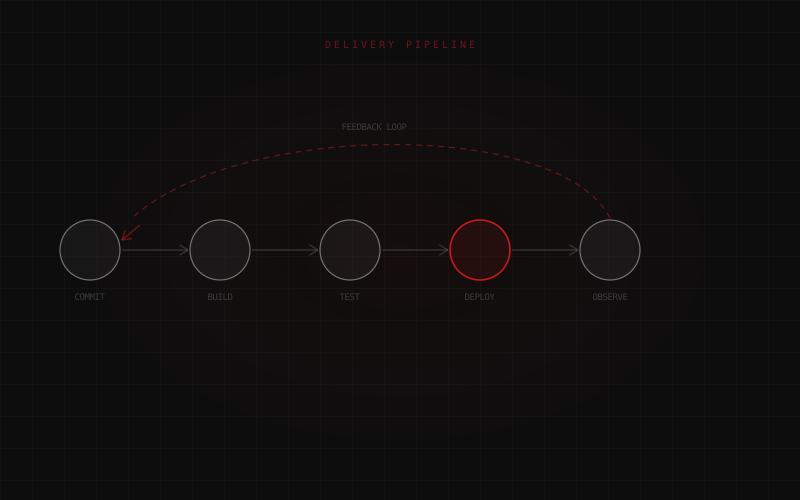
DAM Networks provides managed DevOps as a dedicated service — not a project that ends when the pipeline is deployed, but an ongoing operational function covering CI/CD pipeline management, infrastructure automation, monitoring, and cloud operations. The engineering team delivers product. DAM manages the infrastructure that product runs on.

CAPABILITIES

What DAM delivers as a managed DevOps service

CI/CD Pipeline Design and Management

Pipeline design and ongoing management for GitHub Actions, GitLab CI, CircleCI, and Jenkins environments. Covers build, test, security scan, and deployment stages — with deployment strategies matched to each workload's risk profile.

Infrastructure as Code

Terraform and Pulumi infrastructure codebase design, module library development, state management, and drift detection. Infrastructure changes go through the same review and deployment process as application code.

Monitoring and Observability

Metrics, logging, and tracing infrastructure design and management. Alert configuration calibrated to production behaviour — not default thresholds that generate noise without signal. Runbook documentation for on-call teams.

Cloud Operations

Ongoing cloud infrastructure management including patching, cost reporting, security posture review, and capacity planning. Incident response with defined SLA. Monthly infrastructure review with the engineering leadership team.

DAM APPROACH

Managed DevOps begins with an audit of the current state — pipelines, infrastructure code, monitoring, and deployment process — before any changes are proposed.

DAM conducts a DevOps maturity audit at the start of every managed DevOps engagement. The audit covers CI/CD pipeline reliability, deployment frequency, change failure rate, mean time to recovery, infrastructure code coverage, and monitoring completeness. The output is a prioritised remediation plan that addresses the highest-impact gaps first — typically deployment reliability and observability, which affect the engineering team's daily experience most directly.

Infrastructure as code coverage is a metric DAM tracks continuously. Environments where infrastructure has drifted from its IaC definition are a risk — the documented state no longer reflects what is actually running. DAM's managed service includes drift detection and remediation as a standing operational activity, not a periodic project.

The monthly infrastructure review is a structured session covering cost, capacity, security posture, and delivery metrics with the engineering leadership team. The review is not a status report — it is a planning session that adjusts the service focus based on what the business needs in the coming period. Engineering leaders have a clear view of infrastructure health and cost without needing to extract it from operational systems themselves.

WORK WITH DAM NETWORKS

If deployment reliability is limiting delivery speed and the engineering team does not have the capacity to fix the infrastructure and deliver product simultaneously, that is a managed DevOps problem.

DAM Networks provides managed DevOps services for enterprise engineering teams across AWS, Azure, GCP, and Kubernetes environments. Engagements begin with a DevOps maturity audit before any infrastructure changes are proposed.

FREQUENTLY ASKED QUESTIONS

Questions about managed DevOps services

A single internal DevOps hire covers one person's skill set and is unavailable during holiday, illness, or when they leave. A managed DevOps service covers a team with specialist skills across CI/CD, IaC, cloud operations, and security — with continuity built into the service model. The managed service also has a defined scope, SLA, and monthly reporting structure that an internal hire does not come with by default. For organisations that need DevOps capability consistently rather than occasional project support, managed services typically provide more reliable coverage at a comparable total cost.

DAM manages pipelines on GitHub Actions, GitLab CI, CircleCI, Jenkins, Azure DevOps, and Bitbucket Pipelines. The tool recommendation for new environments is GitHub Actions for most organisations — the native GitHub integration, marketplace ecosystem, and hosted runner model reduce operational overhead compared to self-hosted alternatives. Organisations with existing toolchain investments are supported on their current platform rather than required to migrate.

Terraform's plan output in a scheduled CI job compares the IaC definition against the actual infrastructure state and flags any differences. For AWS environments, AWS Config also detects configuration changes outside the IaC pipeline. When drift is detected, the remediation approach depends on the change: if it is an approved emergency change that was not yet codified, the IaC is updated to reflect it; if it is an unauthorised change, it is reverted through the pipeline. The drift detection run is part of the daily operational process, not a periodic audit.