
Daily
Deployment frequency increased from bi-weekly to daily for a financial services product team following pipeline redesign and environment automation, reducing change lead time from 14 days to under 36 hours.
ENTERPRISE TECHNOLOGY / DEVOPS
The problem is rarely the code. Engineering teams at enterprise organizations regularly build software that works well thoughtfully architected, properly tested, reviewed to a high standard. Then it takes three weeks to get to production. Our DevOps consulting practice closes this gap, producing delivery capability that is faster, more reliable, and operationally sustainable. Part of the Enterprise Technology capability, within the Cloud and Infrastructure cluster.
Talk to Our TeamTHE DELIVERY VELOCITY PROBLEM
Every organization that runs software at scale carries a version of the same delivery friction. The specific expression varies some have long manual test cycles, some have environment provisioning that takes days, some have release governance processes that require six stakeholder sign-offs before anything goes to production. The common thread is that the pipeline between working code and value delivered to the business is slower and less reliable than the engineering capacity feeding into it would suggest.
At the sprint level this feels like execution friction. At the program level it is a structural constraint on how much of the engineering investment actually reaches production, and how quickly the organization can respond to what it learns from what has shipped. Organizations operating on deployment cycles measured in weeks or months are not just slow they are carrying a compounding opportunity cost relative to competitors who ship continuously and iterate on real user behavior.
The DevOps gap is the space between good software architecture and a delivery pipeline that deserves the engineering quality flowing through it. Closing it requires changes to how pipelines are built, how environments are managed, how releases are governed, and how teams respond when things go wrong in production. These are not configuration problems. They are program design problems, and they require the same structured approach as any other enterprise capability investment.
WHAT DAM IMPLEMENTS
DAM builds the delivery programs and operational practices that enterprise technology teams need to ship reliably and recover quickly. Each capability below addresses a distinct layer of the delivery and reliability problem.
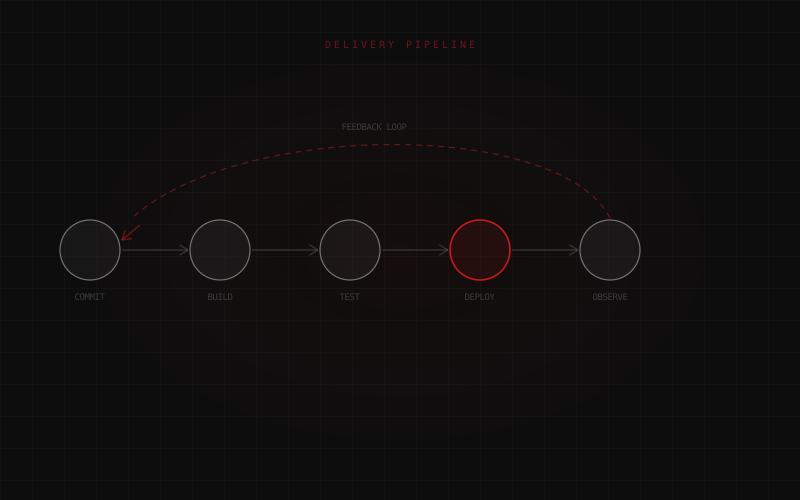
DAM designs and implements CI/CD pipelines from the ground up or restructures pipelines that have grown incrementally without a coherent architecture. The work covers source control workflows, build automation, test integration, artifact management, environment promotion, and deployment strategy including blue-green, canary, and feature-flag approaches for organizations where zero-downtime deployment is a hard requirement.
Container orchestration at enterprise scale introduces its own delivery and reliability challenges: cluster management, workload scheduling, resource governance, multi-environment consistency, and the operational practices that keep containerized environments performing under real load. DAM designs Kubernetes environments that handle these concerns at the architecture level. Full capability detail is available on the Kubernetes consulting page.
Organizations that need DevOps capability without the internal headcount to build and maintain it can engage DAM on a managed basis. DAM operates the pipeline, manages the tooling, monitors the environments, and handles incident response giving the engineering team access to a mature DevOps capability from the start of the engagement rather than after an 18-month internal build program. Details on the managed DevOps page.
Site reliability engineering translates reliability goals into operational practices: defining service level objectives, building the monitoring and alerting infrastructure that tracks performance against those objectives, and designing the incident response processes that the team follows when objectives are breached. DAM implements SRE practices proportionate to the organization's scale and maturity not as a wholesale methodology, but as a structured capability that builds over the course of the engagement.
HOW ENGAGEMENTS WORK
DevOps engagements follow a structured sequence, but the pace and emphasis depend on the current state of the delivery pipeline and the organization's most pressing reliability constraints.
A structured review of how code moves from commit to production: pipeline architecture, environment management, release governance, monitoring coverage, and incident response history. The output is a prioritized picture of what to address first and what the target state looks like.
DAM designs the target pipeline architecture based on the current-state findings: branching strategy, build and test automation, artifact management, environment provisioning, deployment tooling, and governance checkpoints. Reviewed with engineering and operations leadership before implementation begins.
Pipeline components are implemented in phases ordered by impact. High-friction manual steps are automated first. Monitoring and alerting goes in before the delivery cadence increases. Shipping faster without visibility is not an improvement. Each phase is measured against the baseline from the assessment.
DAM builds internal capability to operate and extend what is implemented through documentation, knowledge transfer, and working alongside the engineering team through the first release cycles. The objective is that the team is more capable at the end of the engagement than at the start.
For organizations that want DAM to operate the delivery environment on an ongoing basis, that is available through the managed DevOps program. For those building toward full internal ownership, DAM structures a defined transition with capability verification before handover.
ENGAGEMENT OUTCOMES
These are representative outcomes from DevOps consulting engagements. Specific program details are available in our case studies.
Deployment frequency increased from bi-weekly to daily for a financial services product team following pipeline redesign and environment automation, reducing change lead time from 14 days to under 36 hours.
Production incident rate reduction for a SaaS platform following structured observability, automated rollback, and on-call runbook redesign. Mean time to resolution dropped from 3.1 hours to under 45 minutes.
Release cycle cut from 22 days to 4 days for an enterprise application team after replacing a manual multi-step deployment process with an automated pipeline, freeing approximately 30 engineering hours per release cycle.
FREQUENTLY ASKED QUESTIONS
DevOps consulting addresses the delivery pipeline, release practices, and operational reliability of how software moves from development to production. It includes CI/CD design, infrastructure as code, observability, and incident response. Platform engineering is a more recent framing that typically refers to building internal developer platforms the tooling, self-service infrastructure, and shared services that development teams consume. The two overlap, but DevOps consulting is focused on the delivery and reliability layer, while platform engineering is focused on the internal tooling layer that teams use to interact with that delivery infrastructure. Most enterprise organizations benefit from both, but they are solving different problems. DAM's DevOps practice addresses the delivery and reliability layer first, and extends into internal platform capability where the engagement scope and organizational readiness support it.
Validated delivery pipelines for pharmaceutical systems require that the deployment process itself is treated as a controlled, documented system. This means the pipeline infrastructure is qualified, changes to the pipeline go through a defined change control process, deployment events are logged with sufficient detail to satisfy audit review, and the documentation trail that computer system validation requires is maintained throughout the pipeline's operational life. DAM designs pharma DevOps programs with this validation architecture as a foundation, not as a retrofit applied after the pipeline is operational. The outcome is a delivery program that can satisfy regulatory review at the pipeline level, not just at the application level. See our pharma and healthcare practice.
The managed model makes sense when the organization needs a mature delivery capability faster than an internal build program can deliver it, when the engineering team's capacity is better allocated to product and feature work than to pipeline operations, or when the current state of internal DevOps capability is not sufficient to support the release cadence the business requires. Building internal capability makes sense when the organization has the hiring runway, the engineering leadership to develop and retain DevOps engineers, and a delivery program complex enough to justify the investment in a dedicated internal function. Many organizations use a managed model initially and transition to internal ownership over 18 to 24 months as capability is built. DAM structures engagements to support both paths. Full details are on the managed DevOps page.
Kubernetes delivers the most value when the organization is running containerized workloads at a scale where manual container management is creating operational overhead, when deployment consistency across environments is a persistent problem, or when the workload mix requires the kind of scheduling, scaling, and resource isolation that Kubernetes provides. Organizations that are still deploying monolithic applications to virtual machines, or that have limited internal experience with containers, typically benefit more from establishing CI/CD fundamentals and containerization practices before introducing orchestration complexity. DAM assesses Kubernetes readiness as part of the current-state review and recommends adoption timelines that match the organization's current infrastructure maturity and team capability. See the Kubernetes consulting page for the full capability picture.
The first measurable changes appear within the first eight to twelve weeks for most engagements typically in deployment frequency, environment provisioning time, and the reduction of manual steps in the release process. Incident rate improvements follow after the observability and response infrastructure is in place, usually within three to four months of implementation. The compounding return comes over a longer horizon: engineering capacity freed from release coordination, reduced incident recovery time, and the commercial value of shipping product improvements to customers on a faster cycle. Organizations that measure the program against the baseline captured in the current-state assessment see the return clearly. Those that measure only against the cost of the engagement without measuring the current cost of slow delivery often undercount the return significantly.
START THE CONVERSATION
Delivery velocity and operational reliability are not outcomes that emerge from buying the right tools. They come from designing the right pipeline, building the right practices, and giving the team the capability to sustain them. If the organization is shipping more slowly than its engineering investment warrants, recovering from incidents more slowly than the business can absorb, or treating every release as a coordinated risk event, those are solvable problems with a defined program structure behind the solution.