34%
Infrastructure cost reduction in year one following a structured re-architecture and migration program, achieved through workload right-sizing, reserved capacity planning, and elimination of idle infrastructure.
ENTERPRISE TECHNOLOGY / CLOUD
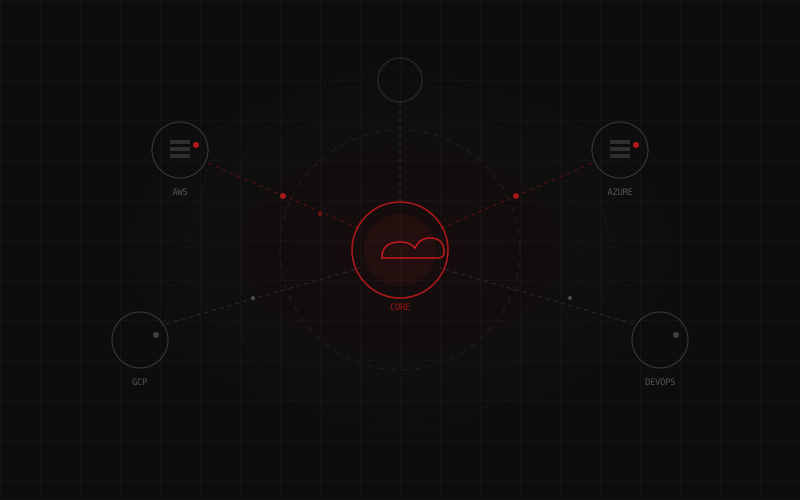
DAM Networks cloud consulting services design and operate cloud architecture for enterprises that need deployment speed, operational resilience, and cost discipline. AWS, Azure, Google Cloud, and multi-cloud programs built around what the business needs to accomplish.
The infrastructure decision precedes the business requirement, the migration method defaults to replication, and the measure of success is set at cost reduction rather than operational capability.
Cloud programs are most commonly initiated by IT on infrastructure economics or vendor end-of-life pressure, before any analysis of what the organization needs the infrastructure to support. This produces an architecture that fits the current state rather than one that enables the intended future state.
Replicating existing architecture in a cloud environment imports every constraint, every inefficiency, and every scaling limitation that existed before the migration, now running on a different billing model.
A cloud program that delivers 20% cost reduction while leaving deployment cycles and operational resilience unchanged has measured itself against the wrong objective. Cost reduction is a by-product of well-designed architecture, not the objective.
WHAT A WELL-DESIGNED ARCHITECTURE DELIVERS
The operational and commercial benefits of cloud infrastructure are specific and measurable. They are also contingent on architectural decisions that have to be made at the design stage, not retrofitted after migration.
Development teams release faster when the infrastructure layer supports rapid, controlled deployment rather than requiring manual environment provisioning or change-request windows. Well-designed cloud environments reduce the time from code-ready to production measured in hours and days, not weeks.
Cloud architecture designed for resilience distributes workloads across availability zones, automates recovery from failure states, and eliminates the single points of failure that make on-premise environments fragile under load. The outcome is measured in uptime percentage and mean time to recovery.
Proper architecture separates workloads by cost profile, uses reserved and committed-use capacity where demand is predictable, and builds alerting and governance into the operating model so that cost changes are visible before they become problems.
Organizations that attempt to run AI programs on infrastructure not designed for the data architecture those programs require run into throughput constraints, cost overruns, and governance gaps. The infrastructure decision made during a cloud program determines what the organization can build on top of it.
THE FULL PRACTICE SCOPE
DAM's cloud practice covers the full range of what enterprise organizations need: architecture strategy, migration execution, platform-specific implementation, and ongoing operations. Each capability is available as part of an integrated program or as a focused engagement depending on where the organization is.
DAM designs cloud environments from the business requirement outward: workload behavior, regulatory requirements, and what the infrastructure needs to look like in three years. The output addresses provider selection, network design, security posture, and data residency.
Migration executed with continuity as the governing constraint. Sequence, cutover approach, rollback procedures, and parallel-run periods are all designed so the business does not experience the migration as a disruption.
Cloud Migration →Implementation capability across AWS, Azure, and Google Cloud, with multi-cloud architectures where the workload distribution justifies the added management complexity.
DAM structures the operating model for the environments it deploys, including DevOps practices, automation tooling, and managed operations that keep cloud environments performing and cost-disciplined after go-live.
DevOps Consulting →HOW ENGAGEMENTS WORK
No two cloud programs are structured identically, but every engagement follows the same analytical sequence.
The starting point is a structured conversation about what the organization needs the infrastructure to support: growth projections, new capability timelines, compliance requirements, and the operational performance standards the organization's workloads are held to.
DAM assesses the existing environment: what is running, how it is connected, performance characteristics under load, single points of failure, and compliance posture. This determines what can be migrated efficiently, what needs re-architecting, and what should be retired.
The cloud architecture is designed against the business requirement and current-state findings, not a template. Provider selection, topology, network design, data architecture, security model, and operating model are all specified before any implementation begins.
Migration execution is sequenced by risk profile and business criticality. Each migration has defined entry criteria, a cutover plan, a parallel-run period, and rollback procedures. The business continues to operate throughout.
The environment after migration is the starting point for an operating model that maintains performance, controls cost, and keeps the security posture current. DAM either hands it to the internal team with documentation and training, or operates it through the managed services model.
PROGRAM OUTCOMES
These are representative outcomes from cloud infrastructure and migration engagements. Specific details are available in our case studies.
Infrastructure cost reduction in year one following a structured re-architecture and migration program, achieved through workload right-sizing, reserved capacity planning, and elimination of idle infrastructure.
Deployment cycle reduced from 11 days to 2 for a manufacturing organization following implementation of automated deployment pipelines on cloud-native infrastructure.
Reduction in mean time to recovery. Production downtime reduced from 4.2 hours per month to under 22 minutes following a resilience re-architecture for a financial services platform.
COMMON QUESTIONS
The decision between a single-provider and multi-cloud architecture should follow the workload requirements, not a positioning preference. A single primary provider reduces management complexity, strengthens the negotiating position, and simplifies the skills requirement for the operating team. A multi-cloud architecture makes sense when specific workloads are genuinely better served by a particular provider's services, when regulatory requirements mandate geographic separation that one provider cannot satisfy, or when the risk of dependency on a single provider's availability and pricing is operationally significant for the organization. Multi-cloud adds real complexity: vendor-specific tooling, inter-provider data transfer costs, more complex identity and access management. That complexity is justified when the workload requirements demand it, not as a default architecture.
Migration timelines vary significantly based on the number of workloads being migrated, the complexity of the current architecture, and the degree to which workloads need to be re-architected before migration rather than moved as-is. For a mid-size enterprise with 50 to 100 workloads and moderate interdependency, a structured migration program typically runs 9 to 18 months from architecture design through post-migration stabilization. That timeline includes a current-state assessment, architecture design, migration sequencing, the migrations themselves, and a stabilization period before the old environment is decommissioned. Organizations that attempt to compress this timeline by skipping assessment or running migrations in parallel before individual workloads are stable tend to extend the total program duration rather than reduce it.
Data residency requirements whether driven by financial regulation, healthcare data law, or cross-border data transfer restrictions are addressed at the architecture design stage, not as a post-migration configuration. This means selecting provider regions that satisfy residency requirements, designing the data architecture so that regulated data does not cross boundaries it is not permitted to cross, configuring the encryption and key management model to meet the relevant standard, and building the audit trail that the regulatory environment requires. For organizations in multiple jurisdictions, the architecture has to satisfy multiple residency frameworks simultaneously, which affects provider selection, network topology, and data governance policy. These requirements are documented before any migration begins, not discovered after workloads are in production.
Cloud cost optimization after migration has two components: structural cost reduction through architecture decisions, and ongoing cost governance through operational discipline. Structural cost reduction involves right-sizing compute capacity that was over-provisioned during migration, purchasing reserved or committed-use capacity for predictable workloads to replace on-demand pricing, and identifying and decommissioning infrastructure that is running but no longer serving a workload. Ongoing cost governance means real-time cost visibility with alerting for anomalies, tagging disciplines that attribute cost to business units or products, and a defined review cadence that identifies cost drift before it accumulates. Organizations that treat cost optimization as a one-time post-migration activity find that cloud costs grow back toward pre-migration levels within 12 to 18 months. Organizations that build governance into the operating model maintain the cost discipline long-term.
The right model depends on the organization's internal capability and where the team's time is most valuably spent. Organizations with strong internal DevOps and infrastructure capability, and whose business generates enough infrastructure complexity to justify maintaining that capability, are well-positioned to operate their own environment with defined tooling and governance. Organizations whose core business is not technology, whose internal team is better deployed on product and application work, or who lack the depth to manage a complex cloud environment reliably are better served by a managed operations model. In practice, most enterprise cloud environments benefit from a hybrid structure: the internal team owns architecture decisions, cost governance, and strategic direction; a managed service covers the operational layer monitoring, incident response, patching, and routine configuration management. The engagement model DAM recommends is determined by the organization's capability profile and what produces the best operating outcomes, not by a default preference.
START THE CONVERSATION
Cloud architecture decisions are compounding. The choices made during a migration or initial cloud design affect how fast the organization can build, what it will cost to operate, and what the business can build on top of that infrastructure for the next several years. Getting the architecture right at the start is significantly less expensive than correcting it after workloads are running in production.