DIGITAL TRANSFORMATION · BUSINESS PROCESS AUTOMATION
Business Process Automation Measured in Cycle Time and Error Rates, Not Licences Deployed
Most automation projects start with a tool and go looking for a process to apply it to. DAM Networks starts with the process: how work actually moves through approvals, documents, and handoffs, where it stalls, and where errors enter. Automation is then designed against that map, and the result is reported in cycle time reduced and error rates lowered, not in software deployed.
Automating a process nobody has mapped produces a faster version of the same broken workflow.
The common failure pattern in process automation is tool selection before process understanding. A platform is licensed, a workflow is rebuilt inside it as it currently exists, and the organisation discovers that the delays were never in the manual steps but in the approval chain, the document handoffs, and the exceptions that fall outside the happy path. The exceptions then route back to the same people as before, and the measured cycle time barely moves. What was purchased as automation becomes a new interface on an old problem, with a licence cost attached. DAM Networks treats process mapping as the deliverable that determines what to automate, what to redesign first, and what to leave manual because the volume does not justify the build.
CAPABILITIES
What DAM delivers across business process automation
Process Mapping and Baseline Measurement
Documentation of how processes actually run, not how the procedure manual says they run. Cycle time, error rates, rework volume, and handoff delays are baselined before any automation is scoped, so the improvement can be measured against a known starting point.
Approval Chain and Workflow Redesign
Approval chains rebuilt around thresholds and delegation rules rather than replicated as they stand. Multi-step sign-offs that exist for historical rather than control reasons are removed before automation, because automating an unnecessary approval only makes it faster to wait.
Document Flow Automation
Automated generation, routing, validation, and filing of the documents that carry business processes: purchase orders, invoices, contracts, compliance records. Data is extracted and validated at entry so downstream steps stop re-keying and re-checking the same information.
Exception Handling Design
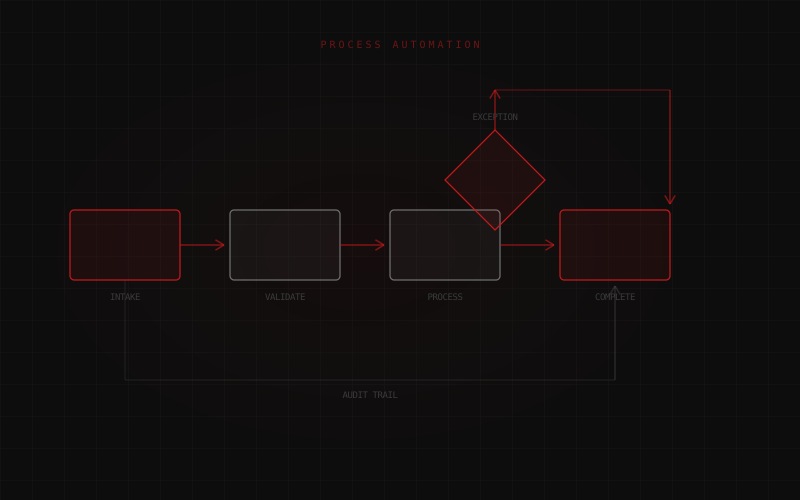
Explicit design for the cases that do not fit the standard path: who is notified, what context they receive, and how the case re-enters the workflow after resolution. Exception design is where most automation programmes fail, so it is scoped as a first-class requirement, not a fallback.
DAM APPROACH
The process map decides the tool, and the baseline decides whether the automation worked.
Every engagement begins with a mapping phase that produces two artefacts: the current-state process with measured cycle times and error rates, and a prioritised list of automation candidates ranked by volume, delay contribution, and error cost. Tool selection follows from that list, which frequently means extending systems the organisation already owns rather than licensing a new platform. Builds are released process by process, each with its own exception paths tested before go-live, and each reported against the baseline. Where the map shows the process itself is the problem, DAM recommends redesign before automation and says so in the roadmap, because the cheapest automation is the step that gets removed.
01
Process Mapping and Baseline
Map the current-state process with measured cycle times and error rates, producing a baseline against which every automation result is later judged.
02
Candidate Prioritisation
Rank automation candidates by volume, delay contribution, and error cost. Where the map shows the process itself is the problem, redesign is recommended before automation.
03
Tool Selection
Choose tooling from the prioritised list, which frequently means extending systems the organisation already owns rather than licensing a new platform.
04
Process-by-Process Release
Release builds process by process, each with its own exception paths tested before go-live and each reported against the measured baseline.
RELATED SERVICES
Services that work alongside Business Process Automation
If an automation platform has been live for a year and nobody can state what happened to cycle time, the project automated activity rather than outcome.
DAM Networks scopes business process automation from a measured process map and reports results against a baseline. Engagements start with a mapping phase, not a licence order.
Prioritisation should follow measurement, not intuition. The strongest candidates combine high transaction volume, rule-based decisions, and a measurable cost of delay or error: invoice processing, purchase approvals, employee onboarding paperwork, and compliance documentation typically qualify. Processes with low volume, frequent judgement calls, or unstable rules are poor first candidates because the exception rate erodes the return. A mapping phase that baselines cycle time and error rates across candidate processes usually reorders the intuitive priority list, and it also identifies processes where a redesign of the approval chain delivers most of the benefit before any software is built.
Because the delay in most business processes is not in the manual work but in the waiting: items sitting in approval queues, documents waiting for missing information, and exceptions parked with someone who handles them weekly. Automating the manual steps compresses minutes while the days of queue time remain untouched. Projects that replicate the existing workflow inside a new tool inherit this structure exactly. Cycle time falls when approval chains are redesigned around thresholds, when data is validated at the point of entry so items stop bouncing back, and when exceptions have a defined owner and resolution path instead of an informal one.
Exception handling is designed by cataloguing the failure cases during process mapping and assigning each one a route before the build starts. Every exception type needs three things defined: the condition that triggers it, the person or role that receives it with full case context, and the mechanism by which the resolved case re-enters the automated flow. Exceptions that occur frequently enough are then treated as candidates for their own automated sub-path rather than permanent manual work. Processes where exception rates exceed roughly one in five transactions are usually signalling a data quality or process design problem that should be fixed upstream, because no exception queue design compensates for inputs that are wrong at entry.
We use cookies to improve this site.We use cookies to understand how the site is used and to improve it. You can accept all cookies or continue with only what is needed. See our Privacy Policy.