

ECOMMERCE & RETAIL
Commerce Revenue Requires More Than a Commerce Platform
DAM Networks works with retail and D2C organizations to close the gap between what the platform can do and what the business is actually extracting from it through technology, performance marketing, and marketplace strategy working as a connected commercial program.
THE CHALLENGE
The Ecommerce and Retail Challenge
Retail organizations navigating the shift from single-channel to multi-channel commerce face a set of problems that do not resolve with additional technology investment alone.
Channel Fragmentation
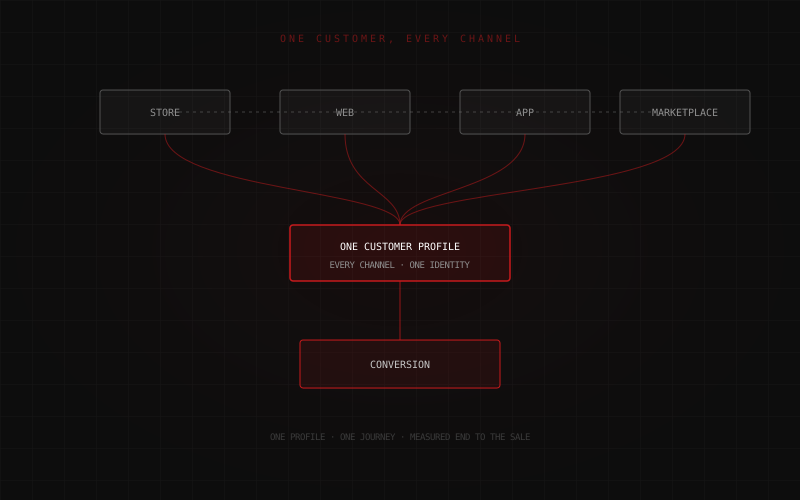
Most retail organizations operate their own website, one or more marketplaces, and social commerce in parallel. These channels run on different data, managed by different teams, with no unified picture of customer behavior across them. Decisions made in one channel create problems in another.
Customer Acquisition Cost Pressure
D2C brands that built their early growth on paid social are facing structural CAC increases as platform costs rise and tracking limitations reduce return on ad spend. Organizations without diversified acquisition programs are absorbing this as margin erosion rather than addressing it as a program design problem.
Marketplace Dependency
For many retail organizations, marketplace revenue has grown as a proportion of total commerce revenue, not because of a deliberate strategic decision, but because marketplace demand exists and was easier to capture than building owned channels. That dependency creates pricing pressure, margin compression, and limited customer relationship ownership.
Technology Debt in Legacy Retail Systems
Retailers that built digital commerce on platforms designed for a simpler channel mix are now carrying systems that cannot support multi-channel commerce with unified inventory, customer data, and fulfillment. The cost of operating across disconnected systems shows up in inventory errors, fulfillment delays, and customer experience failures.
TECHNOLOGY
Technology for Ecommerce and Retail
DAM builds the commerce technology infrastructure that retail and D2C organizations need to operate across channels without accumulating the operational friction that disconnected systems create.
Ecommerce Platform Development
Whether an organization is building its first owned commerce channel or rebuilding a platform that has become a constraint rather than a capability, DAM approaches platform decisions as commercial decisions before engineering ones. The platform architecture follows from channel strategy, not the other way around.
Marketplace Integration
Operating effectively across multiple marketplaces requires more than product listings. DAM builds the integration layer that connects marketplace operations to inventory management, order management, and pricing systems, so that marketplace growth does not create warehouse and fulfillment problems.
Order Management and Inventory Systems
Multi-channel commerce with unified inventory, customer data, and fulfillment requires an order management layer capable of handling channel-specific routing rules, split fulfillment, and real-time inventory visibility. DAM builds these systems around the operational complexity of how retail organizations actually fulfill orders.
Commerce APIs and Integration Architecture
Retail technology stacks are rarely built from scratch. DAM designs the integration architecture that connects commerce platforms, ERP systems, marketplace channels, and logistics providers, so that data flows without manual reconciliation.
Ready to discuss your commerce program?
Talk to Our TeamMARKETING
Marketing for Ecommerce and Retail
Platform capability produces revenue only when the right acquisition, conversion, and retention programs are running against it. DAM designs marketing programs for retail and D2C organizations with CAC and revenue per customer as the primary measures of program health.
Performance Marketing for D2C and Retail
Paid acquisition for commerce is not a budget allocation problem. It is a program architecture problem. DAM builds performance marketing programs that account for the full CAC picture, including which channels are acquiring customers who retain versus customers who return once and disappear. See Performance Marketing.
Marketplace Marketing
Organic marketplace ranking and paid marketplace placements operate differently from search and social. DAM manages marketplace marketing programs that build category position, improve product discoverability, and protect margin from discount-driven competitors.
Retention and Loyalty Programs
Customer retention is the most consistently underinvested commercial program in retail. DAM designs retention programs built around purchase frequency, category expansion, and reactivation, measured in repeat purchase rate, AOV growth, and customer lifetime value, not email open rates.
Social Commerce
For D2C brands where product discovery happens on social platforms before it happens on a website, DAM builds social commerce programs that treat discovery, consideration, and conversion as a connected commercial sequence rather than separate channel objectives.
SERVICES
How DAM Works With Ecommerce and Retail Organizations
Retail and D2C engagements at DAM begin with a commercial audit rather than a technology assessment. The audit drives the program recommendation: and the technology team and marketing team work from the same commercial brief against the same revenue targets.
Ecommerce Development
Commerce platform architecture that follows from channel strategy built to handle the transaction volumes and operational complexity the business expects to reach.
Learn More →Marketplace Management
Listing optimization, sponsored product architecture, and a review generation program that builds category position and protects margin from discount-driven competitors.
Learn More →Omnichannel Commerce
The integration layer connecting POS, warehouse, and commerce platform enabling real-time inventory visibility and unified fulfillment across all channels.
Learn More →Performance Marketing
Acquisition programs designed around customer lifetime value connecting media performance data to retention and repeat purchase data for measurable commercial outcomes.
Learn More →Digital Transformation
full-cycle program design that sequences technology modernization and marketing program build against commercial targets not as a project, but as a business outcome program.
Learn More →Data and Analytics
Commerce analytics connecting channel revenue, CAC by acquisition source, and retention cohort data into a single commercial picture that drives program decisions.
Learn More →COMMERCE OUTCOMES
Commerce Outcomes
D2C Apparel CAC Reduction
31%
Blended CAC reduction within three quarters. ROAS on paid social improved from 1.4x to 2.6x. New customer cohorts returned to positive contribution margin within first 90 days of purchase.
Marketplace Seller Revenue Recovery
28%
Marketplace revenue growth over two quarters while average selling price held. Marketplace revenue concentration reduced from 74% to 58% by building the owned commerce channel in parallel.
Specialty Retail Omnichannel Build
18pts
Online conversion rate improvement on previously affected product categories after real-time inventory integration. BOPIS launch drove 9% increase in average order value versus standard delivery orders.
FREQUENTLY ASKED QUESTIONS
Frequently Asked Questions
How does an organization decide which ecommerce platform is right for its commercial model?
Platform selection is a commercial decision before it is a technology decision. The right platform depends on the channel mix the organization intends to operate, the level of customization required by the product catalog and pricing model, the integration requirements with existing ERP and inventory systems, and the expected transaction volume and growth trajectory. Organizations that select platforms based on feature lists or peer benchmarks frequently find that the platform creates commercial constraints as they scale. DAM approaches platform selection by mapping commercial requirements first, then evaluating which platform architecture serves those requirements without creating operational problems at the volumes and complexity levels the organization expects to reach.
What is a sustainable marketplace strategy for retail organizations that want to grow owned channels?
Marketplace dependency is a commercial risk that most retail organizations have accumulated without a deliberate decision to do so. A sustainable marketplace strategy involves three elements: managing marketplace presence to protect margin and category position rather than chasing volume at the expense of pricing integrity; building owned channel capability that gives customers a reason to buy direct; and designing the economics of each channel so that customer acquisition through marketplaces can, over time, migrate retention and repeat purchase to the owned channel. This requires both technology infrastructure and a customer retention program, and neither alone is sufficient.
What are the trade-offs between D2C commerce and marketplace commerce, and how should organizations balance them?
D2C commerce offers higher margins, full customer data ownership, and the ability to build a direct relationship with the buyer. Marketplace commerce offers reach, existing demand, and lower customer acquisition cost at the top of the funnel. The trade-off is not binary. Most retail organizations that perform well operate both channels with a clear view of what each channel is supposed to do commercially. Marketplace is used for customer acquisition and category presence. D2C is used for retention, higher-margin repeat purchase, and customer relationship ownership. Organizations that treat these as competing channels rather than complementary ones tend to underinvest in the channel design that makes both work.
How does performance marketing for ecommerce differ from performance marketing in other sectors?
Commerce performance marketing operates against a more immediate and measurable revenue signal than B2B or pharmaceutical marketing. ROAS, conversion rate, AOV, and CAC by cohort are available in near real-time, which creates both the opportunity and the temptation to optimize for short-term metrics that do not reflect long-term commercial health. The organizations that consistently improve commerce marketing performance are those that design their acquisition programs around customer lifetime value rather than first-purchase ROAS. That requires connecting media performance data to retention and repeat purchase data, which most organizations have not done because the data sits in separate systems.
How complex is the technology integration required for multi-channel commerce with unified inventory and fulfillment?
The complexity depends heavily on the age and architecture of the existing retail systems. Organizations running modern commerce platforms with well-documented APIs can typically achieve meaningful integration within a structured program scope. Organizations carrying legacy ERP systems or point-of-sale infrastructure with limited API capability face a more significant integration program, and in some cases, a parallel system modernization. The commercial cost of not completing the integration is quantifiable: inventory errors, fulfillment failures, and the customer experience damage that comes from selling items that cannot be shipped. Most retail organizations that have priced the integration cost against the operational cost of disconnected systems have found the integration economics favorable within the first year of operating the connected system.
Build Commerce Revenue That Does Not Depend on a Single Channel
If your commerce operation is technically functional but commercially underperforming, the problem is rarely the platform. It is the program that sits around it. DAM works with retail and D2C organizations to build the acquisition, retention, and marketplace programs that convert commerce infrastructure into predictable revenue.