

EDUCATION & LEARNING
Learning Technology That Produces Completion, Not Just Enrollment
Organizations buy learning platforms with conviction and watch completion sit at 31% six weeks after go-live. The platform is rarely the problem: most deployments treat platform selection as the primary decision and instructional design, content architecture, and adoption as afterthoughts. DAM designs the program and the platform together.
THE CHALLENGE
The Learning Technology Challenge
Platform adoption and completion are not the same measurement. Organizations that track one while ignoring the other discover the gap too late.
Platform Adoption vs. Completion Gap
A workforce learning platform can show 90% enrollment and 28% module completion at the same time. That is not a learner motivation problem. It is a content design, accessibility, or workflow integration problem that was never resolved in the deployment.
Distributed Workforce Complexity
Production workers across three shifts, field sales teams needing content consumable in under 12 minutes, compliance programs needing audit-ready records: standard LMS configurations serve none of these out of the box.
EdTech Go-to-Market Stall
EdTech products are built with genuine instructional quality and then stall at 400 paying customers because the commercial infrastructure to grow was not built alongside the product. B2B EdTech requires a sales motion, a content marketing program, and a pricing architecture that enterprise buyers will engage with. Building the product without building the go-to-market is the most common failure pattern in EdTech.
Sequencing Error: Platform Before Program
Organizations that sequence the technology decision before the instructional design brief pay for that decision in completion data. The instructional design brief and the technology brief need to be written together. Platform first, program design second is a sequencing error that does not resolve itself after go-live regardless of how capable the platform is.
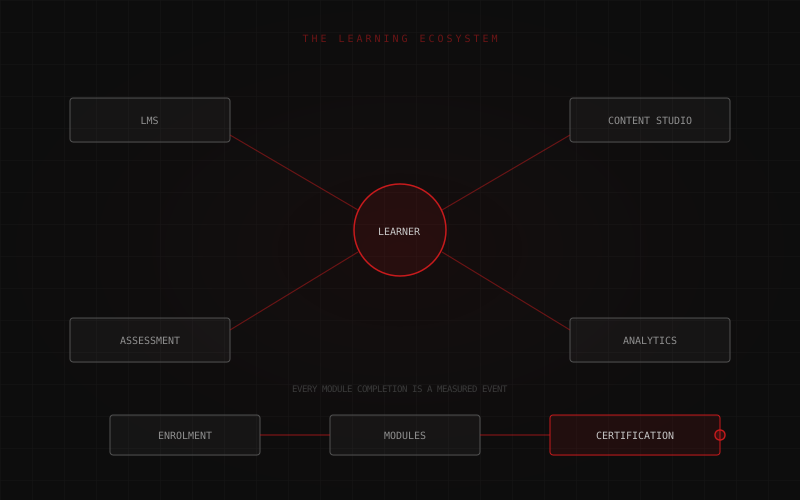
HOW DAM WORKS
How DAM Works With Education and Learning Organizations
DAM Networks works with two distinct types of organizations in education and learning: EdTech companies building digital learning products and platforms that need to scale commercially, and enterprise organizations deploying internal learning infrastructure for workforce development. The problems differ in form but not in structure.
- Enterprise organizations: engagements begin with a diagnostic of the current learning program, covering completion rates, manager visibility, content architecture, and platform configuration.
- EdTech companies: the starting point is a commercial diagnostic covering acquisition unit economics, where the go-to-market motion is stalling, and the path to the next revenue milestone.
- Both engagement types share one accountability model: the program outcome is defined at the start, and delivery is measured against it. See Digital Transformation for the full engagement model.
- Technology build components draw on DAM's enterprise technology and custom software development practices.
Ready to discuss your learning program?
Talk to Our TeamTECHNOLOGY & SERVICES
Technology for Education and Learning
Learning Management System Development
A learning management system built for a specific organization's workforce is a different product from a configured off-the-shelf platform. When the workforce is distributed, when completion data needs to feed into HR and compliance systems, when content needs to be delivered across devices in conditions where connectivity is inconsistent, and when the measurement framework needs to track behavioral outcomes rather than time-on-platform, the configuration limits of commercial platforms become relevant quickly.
DAM builds custom LMS platforms and extends existing platforms for organizations whose requirements exceed what standard configurations support. For organizations deploying LMS in regulated environments, the audit trail and completion record requirements are treated as first-order constraints in the platform design. Our dedicated pharma LMS practice covers the specific requirements of pharmaceutical field force certification in detail.
EdTech Platform Development
EdTech platform development covers the full range of digital learning product builds: consumer learning applications, B2B corporate training platforms, professional certification systems, and institutional learning environments. The build scope typically includes content delivery architecture, assessment and progress tracking, learner onboarding flows, instructor or administrator tooling, and the integration layer connecting the learning platform to the organization's commercial systems.
DAM approaches EdTech platform builds with the commercial model and the growth architecture as part of the initial design brief. A platform that cannot support enterprise SSO, bulk seat provisioning, or granular usage reporting will not close mid-market enterprise deals regardless of how strong the content is.
SCORM, xAPI, and Standards Integration
SCORM compliance and xAPI integration determine whether a learning program can operate portably across systems, track learner behavior beyond simple completion events, and connect learning activity data to broader organizational data environments. For enterprise organizations deploying learning content across multiple platforms or integrating third-party content into a proprietary LMS, standards compliance is a procurement and governance requirement as much as a technical one.
DAM's technical practice covers SCORM 1.2, SCORM 2004, xAPI (Tin Can), and cmi5 implementation across both platform builds and content authoring environments. For organizations migrating from legacy SCORM content libraries to xAPI-enabled platforms, DAM designs the migration architecture and the data mapping required to preserve historical completion records and learning history.
Assessment and Certification Platforms
Assessment architecture sits at the intersection of instructional design and technology. The question of whether an assessment is measuring the right competency is an instructional design question. The question of whether it is delivered securely, at scale, with audit-ready results that satisfy a certification body, is a technology question. Both need to be resolved in the same program.
DAM builds assessment and certification platforms for organizations running professional certification programs, compliance verification programs, and internal competency assessments at scale. The build scope includes item bank architecture, adaptive assessment logic, proctoring integration where required, and certificate generation and verification systems.
Learner Acquisition
Consumer-facing EdTech growth is a paid and organic acquisition problem with a content marketing layer. The unit economics are the constraint: cost per acquisition has to sit below a multiple of average revenue per learner, and that relationship has to hold as spend scales. DAM builds learner acquisition programs around the acquisition economics first: channel selection driven by cost per enrolled learner at target completion rate, content marketing built to reduce acquisition cost over time, and paid acquisition programs structured to test against completion and retention outcomes, not just enrollment volume.
B2B Corporate Training Sales
Selling learning programs to enterprise buyers is structurally different from direct-to-learner acquisition. The buyer is an L&D director, a Chief People Officer, or a Head of Compliance, not the person who will complete the training. The evaluation criteria are measurable workforce capability outcomes, compliance record requirements, integration with existing HR systems, and total cost of deployment. DAM's B2B EdTech growth marketing programs are built around the enterprise buying process with content strategy targeting functional buyers at the middle and late stages of the evaluation cycle.
PROGRAM OUTCOMES
Learning Program Outcomes
The following outcomes reflect program results within DAM's education and learning practice. Each represents a distinct program type and organizational context.
93%
LMS Completion Rate
Manufacturing workforce LMS across 2,400 production staff. Completion improved from 52% to 87% at the next quarterly certification window and 93% the cycle after. DAM restructured content into role-specific learning paths of 8-14 minutes per module and built manager dashboards with automated escalation.
USD 41
Cost Per Enrolled Learner with 30-Day Retention
B2C EdTech platform for finance professionals. Cost per enrolled learner with 30-day retention fell from USD 94 to USD 41 within three quarters. 30-day retention improved from 38% to 61% after DAM rebuilt acquisition around organic search and restructured the onboarding sequence.
6.5 wks
Average Time-to-Competency
Financial services compliance program across 1,800 client-facing staff. Time-to-competency reduced from a projected 11 weeks to 6.5 weeks. First-attempt assessment pass rates improved from 61% to 84% after DAM redesigned the learning pathway architecture and introduced spaced repetition scheduling.
Review our case studies for further examples across learning program types and industries.
FREQUENTLY ASKED QUESTIONS
Common Questions
The answer depends on three factors: the specificity of the completion and reporting requirements, the integration complexity with existing HR and operational systems, and the degree to which the learner population's access conditions differ from what commercial platforms are configured to support. Organizations with standard training requirements, a broadly connected workforce, and reporting needs that align to what commercial platforms produce should configure rather than build. Organizations with distributed field workforces requiring offline access, completion data that needs to feed live compliance or safety systems, or learning pathways that need to adapt dynamically to role and certification status will typically find that commercial platform configuration becomes a series of workarounds rather than a solution. DAM's diagnostic process identifies which category an organization falls into before any platform decision is made.
SCORM compliance means the learning content package communicates with the LMS in a standardized format, passing data on completion status, score, and time spent. For enterprise programs, the practical implication is that SCORM-compliant content can be hosted in any SCORM-compliant LMS without rebuilding the content, and that completion records generated by the content are readable by the platform's reporting layer. xAPI extends this by tracking a much wider range of learner behaviors, including informal learning activity, simulation performance, and mobile learning interactions, and by storing that data in a Learning Record Store that can be queried independently of the LMS. For organizations with complex multi-platform content environments or compliance audit requirements, xAPI provides reporting fidelity that SCORM cannot match. The build decision affects both content authoring tooling and platform architecture, and both need to be resolved in the early design phase.
The first step is a commercial diagnostic: what the current customer acquisition cost looks like, which customer segments have the strongest retention and expansion behavior, where the sales motion is stalling (awareness, evaluation, procurement, or post-sale adoption), and what the unit economics need to look like for the next growth stage to be fundable. The recommendation from that diagnostic may include repositioning the product for a more specific buyer, restructuring the pricing architecture for the enterprise segment, building a content marketing program to reduce paid acquisition dependency, or establishing a B2B demand generation program targeting a specific vertical. The sequencing of those activities is determined by where the largest constraint in the growth model sits, not by a fixed program template.
Consumer-facing learning products are built around learner motivation, self-directed progression, and acquisition economics. The product design challenge is retaining learner engagement through a full learning journey without institutional accountability structures. The commercial challenge is acquiring learners at a cost that works at scale, and the metric that matters is retention and completion, not enrollment. Enterprise workforce training platforms are built around organizational accountability structures, manager visibility, compliance record requirements, and integration with HR and operational systems. The learner is often not choosing to be there, which changes the instructional design brief entirely. Completion is driven by workflow integration, manager escalation, and clear connection to role performance, not by learner motivation design. These are fundamentally different product architectures, and the mistake organizations make is applying the design logic of one to the requirements of the other.
Completion is a process measure. Behavior change is an outcome measure, and the two are not the same. The measurement framework needs to be designed before the learning program is built, because behavior change measurement requires data collection points outside the LMS: manager observation records, performance data, customer interaction quality metrics, or assessment of on-the-job application of the competency the program was intended to develop. The specific measurement approach depends on the competency and the role. For a compliance training program, behavior change might be measured through error rate reduction in the relevant process. For a sales skills program, it might be measured through conversion rate change in a specific deal stage. For a technical skills program, it might be measured through reduction in escalations or time-to-resolution. DAM designs the behavior change measurement framework as part of the learning program architecture, not as a post-program evaluation exercise.
START THE CONVERSATION
Discuss Your Learning Program
When a learning program is not producing the completion rates, the behavior change, or the commercial scale it was built to deliver, the gap is almost always in the program design rather than the platform. DAM does not begin with a capability presentation. The starting point is a conversation about what the program is meant to produce and where it is currently falling short.