
CASE STUDY · MANUFACTURING · GROWTH MARKETING
How a Mid-Size Industrial Manufacturer Cut Unqualified Lead Volume by 62% and Moved Lead-to-Opportunity Conversion From 9% to 28%
A B2B industrial equipment manufacturer's demand generation programme was producing volume with no connection to the qualified pipeline the sales team needed. Restructuring it required a definitional agreement before a single campaign change was made.
RESULTS
Five measurable outcomes from a demand generation restructure built against a documented ICP.
62%
Reduction in unqualified leads as a share of total lead volume within two quarters. Unqualified leads fell from 71% to 27% of total volume.
9% → 28%
Lead-to-qualified-opportunity conversion improved over six months through tighter ICP-aligned targeting and procurement-intent campaign architecture.
48%
Reduction in cost per qualified opportunity. Cost per lead was stable. Cost per qualified opportunity fell because the proportion converting to opportunities increased significantly.
18% → 41%
Marketing-attributed pipeline as a share of total open pipeline value within six months, up from less than one-fifth at engagement start.
19 days
Reduction in time from first marketing touchpoint to qualified sales conversation. Median fell from 47 to 28 days as buyers arrived at a more advanced stage of their own evaluation.
CLIENT CONTEXT
The client is a mid-size industrial equipment manufacturer serving B2B buyers across capital procurement, after-market service, and equipment replacement cycles. With a direct sales team and a distribution channel operating across multiple regions, the organisation's commercial success depends on a consistent supply of qualified pipeline, procurement-stage inquiries from buyers with defined budget authority and near-term purchase intent. Against larger multinational competitors, the organisation wins on service responsiveness and application expertise, not price.
BUSINESS CHALLENGE
The programme was generating lead volume. That was not the problem.
The problem was that the volume bore no useful relationship to the pipeline the sales team needed. Inquiries arriving through paid search and web forms were predominantly from early-stage researchers, competitors conducting market scans, and procurement contacts from industries the organisation does not serve. The sales team worked through each of these inquiries because the routing logic treated all form submissions equally. Time spent on unqualified contacts compounded quarter over quarter.
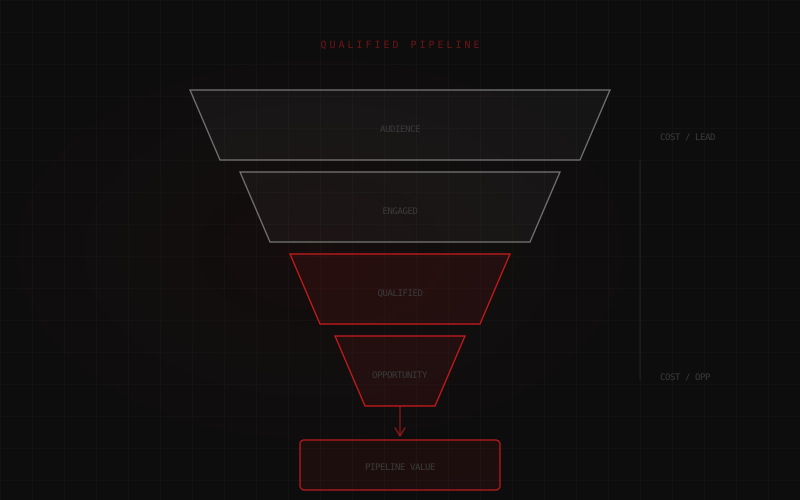
The cost dimension was equally visible. Cost per inquiry had remained relatively stable, which the marketing function reported as an efficiency indicator. What was not being reported was cost per qualified opportunity, a figure nobody had calculated because the definition of a qualified opportunity had never been formally agreed between marketing and sales. Marketing counted form completions. Sales counted contacts that accepted a second call. The gap between those two definitions was where most of the budget was being consumed.
There was no ideal customer profile document that the paid search programme was built against. Campaign targeting had accumulated over time based on keyword performance reports rather than against a defined profile of the buyer type that closed and retained. The programme had optimised itself into a local efficiency maximum that was commercially unproductive.
Attribution compounded the difficulty. Leadership could see total inquiry volume and total cost per inquiry. They could not see which campaigns produced inquiries that became opportunities, which became revenue, and which were written off. Budget decisions were made on channel-level reporting with no connection to commercial outcomes.
DAM APPROACH
DAM entered at the diagnostic stage, not the execution stage. That distinction mattered.
The first four weeks were spent establishing what a qualified opportunity actually looked like for this organisation, not as a marketing abstraction, but as a definition grounded in the sales data. DAM reviewed 24 months of closed-won and closed-lost records, interviewed the commercial leadership and four regional sales managers, and mapped the observable characteristics of buyers who converted at each stage of the pipeline. The output was an ICP document covering industry vertical, organisation size, procurement authority structure, buying trigger type, and the search and content behaviours visible in digital channels before a formal inquiry was submitted.
That ICP definition became the governing document for every subsequent decision. Paid search restructure, content brief, landing page design, lead qualification criteria, all specified against it. The campaign architecture was rebuilt from scratch around procurement-intent search terms: the specific queries buyers use when they are actively evaluating suppliers, not researching product categories.
The content programme was designed around the specific decision concerns procurement-stage buyers in this sector carry. Technical specification comparison, total cost of ownership frameworks, after-sales service architecture, and application-specific case evidence were the content types identified as moving buyers toward a first conversation.
The final component was a pipeline attribution model connecting marketing activity to commercial outcomes. This required integration between the paid platform reporting environment, the CRM, and the sales team's opportunity records. For the first time, leadership had a view of which programmes were producing qualified pipeline and at what cost.
SOLUTION DELIVERED
A demand generation programme built against a documented ICP rather than keyword performance reports.
The paid search architecture distinguishes procurement-intent traffic from research-intent traffic and applies different budgets, landing experiences, and success criteria to each. Negative keyword coverage was expanded significantly to exclude the search patterns that had historically produced high click volume from unqualified audiences.
The landing page environment was rebuilt for procurement-stage conversion. Product category pages on the main site were replaced, for paid traffic, with application-specific landing pages carrying the technical content, social proof, and conversion actions relevant to a buyer at evaluation stage. Each page was built against a specific buyer type identified in the ICP. Conversion rate by page variant is tracked against qualified-opportunity outcomes, not form submissions.
The sales team now receives leads with a content engagement summary attached, which assets a contact viewed before submitting an inquiry, which reduces the qualification conversation to confirming budget and timeline rather than establishing basic fit.
The attribution model generates a weekly commercial dashboard for marketing and sales leadership showing cost per qualified opportunity by campaign source, pipeline value attributed to marketing, and the conversion rate from marketing-sourced lead to qualified opportunity. Sales and marketing now operate from a single view of programme output and a shared definition of what a qualified opportunity requires before it enters the pipeline.
WHAT THIS PROGRAMME DEMONSTRATED
The most consequential finding was not a channel problem. It was a definition problem.
The organisation had never formally agreed what a qualified opportunity was. That absence meant marketing was optimising for volume, sales was working through unqualified contacts, and cost per inquiry was being reported as efficiency while cost per qualified opportunity, the number that connects marketing to commercial outcomes, was invisible and rising. The programme restructure required a definitional agreement before a single campaign change was made. Without it, any execution change would have optimised the same broken system more efficiently.
This pattern is common in industrial B2B marketing. Paid search programmes for manufacturers are frequently built from keyword research outward rather than from buyer definition inward. The result is a campaign architecture that captures search activity efficiently but cannot distinguish procurement intent from general category research. That failure does not surface on the channel dashboard. It surfaces in the sales team's pipeline, where it is consistently misread as a sales performance issue rather than a demand generation design issue.
Running content and paid as integrated functions, rather than separate channels with separate owners, produced compounding results neither would have achieved alone. Buyers who engaged with technical content before submitting an inquiry arrived at the first sales conversation with qualification already partially complete.
RELATED SERVICES
Services relevant to this engagement
WORK WITH DAM NETWORKS
If your paid programme is producing volume without producing qualified pipeline, the right starting point is a conversation about your ICP and what the data says about the buyers who close.
This engagement is relevant to B2B manufacturers, industrial equipment companies, and capital goods organisations where marketing and sales are measuring success differently and where cost per qualified opportunity has never been calculated.
FREQUENTLY ASKED QUESTIONS
Questions about B2B manufacturing demand generation
Structural changes to a paid search programme take effect within days of going live. The commercial signal you care about, lead-to-opportunity conversion rate and cost per qualified opportunity, typically requires 8 to 12 weeks of data to show a reliable trend. The first visible change is lead quality composition, which the sales team notices almost immediately. Pipeline metrics follow at the six to eight-week mark in most programmes.
A qualified lead meets demographic or firmographic criteria, company size, industry, job title. A qualified opportunity is a specific sales situation where a buyer has defined need, budget authority, and a timeline that makes a purchase decision likely within a foreseeable period. Marketing programmes optimised for qualified leads frequently produce contacts who match the profile but are not in an active buying process. The gap between those two numbers is where most B2B marketing budget is consumed without commercial return.
The process starts with closed-won data, not market assumptions. For manufacturers with multiple product lines, the analysis is segmented by product category and sale type, capital equipment, consumables, after-market service, because the buying process, stakeholder structure, and intent signals differ across these categories. A separate ICP profile is built for each. The resulting documents govern campaign targeting, content priorities, and lead qualification criteria for each segment independently.