Enterprise Automation for the Operational Workflows Where Manual Work Actually Costs Money
In warehouses, dispatch operations, and back-office functions, manual steps have a direct unit cost: labour per transaction, delay per shipment, error per order. DAM Networks automates these operational workflows with the right mechanism for each, choosing between RPA and API-level integration on engineering evidence, and designing for the exceptions that operational reality always produces.
Operational automation fails in the field, not in the demo, because operations do not run on the happy path.
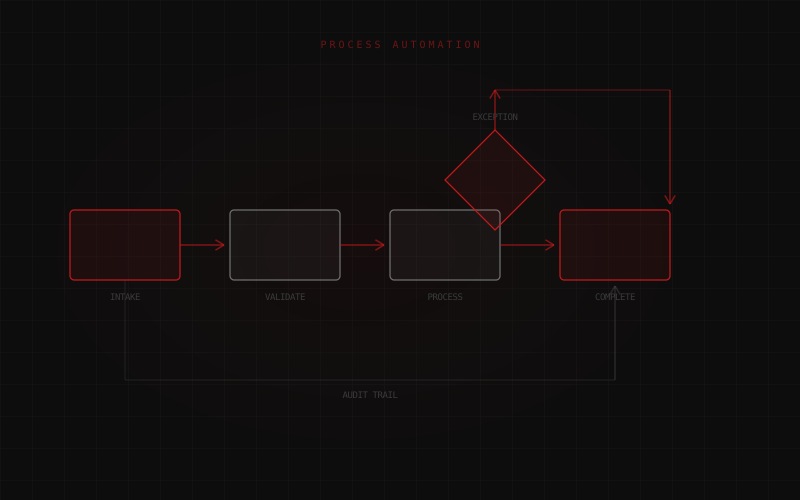
Automation in operational environments confronts conditions that office workflow tools never see: warehouse systems with no modern interfaces, dispatch decisions made under time pressure, carrier and supplier systems that each speak a different format, and a volume of edge cases that grows with every new customer contract. Programmes built for the demonstration scenario stall the first week a scanner feed drops or a carrier changes a label spec, and operations staff quietly revert to the manual process because the shipment cannot wait for a ticket. The technology choice compounds this: RPA bots screen-scraping a legacy WMS are fast to build and fragile to run, while API integrations are durable but not always possible. DAM Networks makes that trade-off explicitly per workflow and designs the exception paths before the automation, because in operations the exceptions are the job.
CAPABILITIES
What DAM delivers across enterprise automation programmes
Warehouse and WMS Process Automation
Automation of receiving, putaway confirmation, wave planning inputs, inventory reconciliation, and labelling workflows around the WMS. Built against the system's real interfaces and the floor's real conditions, with fallback procedures the shift team can execute.
Dispatch and Carrier Workflow Automation
Automated order-to-dispatch flows: carrier selection rules, booking and label generation, manifest submission, and tracking status propagation back to customer-facing systems. Multi-carrier format differences are absorbed in an integration layer, not in staff workarounds.
Back-Office Operations Automation
Automation of the administrative load that shadows operations: proof-of-delivery processing, freight invoice matching and audit, customs documentation, and inter-system reconciliation between WMS, TMS, and finance platforms.
RPA and API Integration Engineering
An explicit mechanism decision per workflow: API-first integration where interfaces exist or can be built, RPA where a legacy screen is the only door, and a documented migration path from bot to interface as systems modernize. Bot estates are monitored like production software.
DAM APPROACH
Choose the mechanism per workflow, design the exception path first, and measure in operational units.
DAM assesses each operational workflow on three axes before building anything: transaction volume and unit cost, the stability and interface options of the systems involved, and the exception profile observed on the floor rather than described in the SOP. The mechanism follows from that assessment. API integration is the default wherever an interface exists or is worth building, because it survives system updates; RPA is used deliberately as a bridge for legacy screens, with its fragility priced in and its retirement planned. Exception routing is designed before the happy path is automated: every failure mode gets a defined owner, an alert with context, and a manual fallback that operations can run without engineering support. Results are reported in the units operations managers already use, orders dispatched per labour hour, dock-to-stock time, invoice match rates, and error rates per thousand transactions.
01
Workflow Assessment
Assess each workflow on transaction volume and unit cost, system stability and interface options, and the exception profile observed on the floor rather than described in the SOP.
02
Mechanism Selection
Choose the mechanism per workflow: API integration as the default because it survives system updates, RPA as a deliberate bridge for legacy screens with retirement planned.
03
Exception Path Design
Design exception routing before automating the happy path. Every failure mode gets a defined owner, an alert with context, and a manual fallback operations can run.
04
Operational Measurement
Report results in units operations managers already use: orders dispatched per labour hour, dock-to-stock time, invoice match rates, and error rates per thousand transactions.
RELATED SERVICES
Services that work alongside Enterprise Automation
If the automation works until the first exception and the floor team keeps a manual workaround ready for that moment, the operation is paying for two processes and trusting one.
DAM Networks automates operational workflows with the exception paths designed first and the mechanism chosen on evidence. Engagements start with a workflow and exception assessment on the operational floor.
API-first integration should be the default wherever the systems involved expose interfaces or can be extended to expose them, because integrations built on defined contracts survive interface redesigns, version upgrades, and load conditions that break screen-level bots. RPA is the right choice in a narrower set of cases: legacy or vendor-locked systems with no accessible interface, workflows too low in volume to justify integration engineering, or interim bridges needed while a system replacement is already underway. The critical discipline is treating RPA as a dated bridge rather than a permanent architecture: every bot should carry monitoring, an owner, and a documented retirement path, because an unmanaged bot estate becomes its own legacy system within a few years.
Business process automation typically addresses office workflows: approvals, document routing, onboarding, and administrative chains where the constraint is queue time and the systems are modern SaaS platforms. Enterprise automation, as DAM practises it, addresses operational workflows: warehouse processes, dispatch, carrier integration, and the back-office load that shadows physical operations. The engineering profile differs materially. Operational automation must handle real-time volume, legacy systems such as an established WMS, hardware inputs like scanners and label printers, and exception rates driven by physical reality rather than data entry mistakes. It is measured in operational units, orders per labour hour or dock-to-stock time, rather than in approval cycle time. Many organisations need both, but they are scoped and engineered as different disciplines.
Because in operational environments the exception rate determines whether the automation survives contact with the floor. A dispatch flow that handles ninety-five percent of orders automatically still produces dozens of stuck shipments per day at scale, and if those cases have no defined route, operations staff resolve them by working around the automation entirely, which erodes trust in the system and eventually kills adoption. Designing exceptions first means every observed failure mode has a trigger condition, an owner who receives the case with full context, and a fallback procedure the shift team can execute without waiting for engineering. It also produces better economics: recurring exceptions become visible in the routing data and can be promoted into automated sub-paths, so the automated share of volume rises over time instead of decaying.
We use cookies to improve this site.We use cookies to understand how the site is used and to improve it. You can accept all cookies or continue with only what is needed. See our Privacy Policy.