B2B Email Marketing Designed Around Pipeline Advancement, Not Send Volume
Email programmes measured on open rates broadcast to a database. Programmes measured on pipeline advancement move contacts through the buying journey. DAM Networks builds B2B email programmes where every sequence is designed around a specific stage in the commercial journey, not a monthly content calendar.
High open rates and click rates do not indicate pipeline advancement. They indicate a well-written email to an engaged list. Those are not the same thing.
Most enterprise B2B email programmes are broadcast channels: a newsletter to the full database, campaign emails tied to product releases, and promotional sequences driven by the content calendar. The metrics reported are open rate, click rate, and unsubscribe rate. None of them tells commercial leadership whether the programme is advancing contacts through the pipeline. The programme looks active. Its commercial contribution is invisible.
CAPABILITIES
What DAM delivers across B2B email marketing programmes
Lifecycle Sequence Design
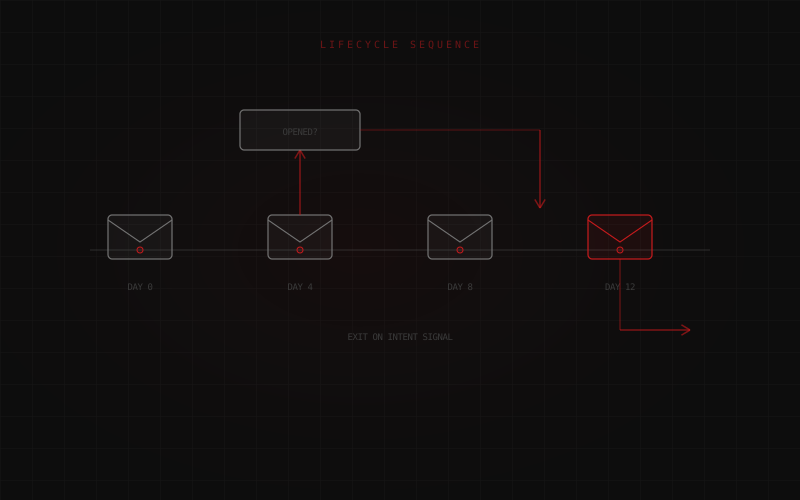
Welcome sequences, nurture tracks, re-engagement sequences, and post-conversion follow-up sequences designed around the commercial journey stages relevant to the ICP. Each sequence has a defined entry trigger, an exit condition, and a next-stage conversion goal.
Segmentation and Personalisation
List segmentation by firmographic profile, engagement level, content consumption, and commercial stage. Dynamic content blocks that tailor email content to segment characteristics without requiring separate campaigns for each segment.
CRM Integration and Attribution
HubSpot, Salesforce, and Marketo integration for pipeline stage tracking, lead scoring alignment, and revenue attribution. Email programme performance measured at the opportunity and revenue level, not only at the engagement metric level.
Deliverability and Technical Setup
Domain authentication (SPF, DKIM, DMARC), sender reputation monitoring, list hygiene management, and deliverability optimisation. Emails that do not reach the inbox cannot produce pipeline contribution regardless of how well they are written.
DAM APPROACH
Email programme design begins with the commercial journey map and the CRM pipeline stages, not with the email platform or the content calendar.
Before any sequence is designed, DAM maps the commercial journey stages for the ICP: what information a contact needs at each stage, what action the programme should drive, and what signal indicates they have advanced. CRM integration is configured at programme start so pipeline contribution is attributable from the first sequence launch. Deliverability is a foundation requirement: domain authentication, list hygiene, and bounce management are established before the first campaign is sent.
01
Commercial Journey Mapping
Map the commercial journey stages for the ICP before any sequence is designed: what information a contact needs at each stage, what action to drive, and what signal indicates advancement.
02
CRM and Deliverability Foundation
Configure CRM integration at programme start so pipeline contribution is attributable from launch, and establish domain authentication, list hygiene, and bounce management before the first send.
03
Lifecycle Sequence Build
Design welcome, nurture, re-engagement, and post-conversion sequences, each with a defined entry trigger, exit condition, and next-stage conversion goal, segmented by profile and commercial stage.
04
Revenue-Level Measurement
Measure programme performance at the opportunity and revenue level through pipeline stage tracking and attribution, not only at the engagement metric level.
If the email programme has strong engagement metrics but no demonstrable pipeline contribution, the sequences are not designed around the commercial journey.
DAM Networks builds B2B email marketing programmes for enterprise organisations. Engagements begin with the commercial journey map and CRM pipeline stages, not the email platform or the content calendar.
Open rate benchmarks for B2B enterprise email vary significantly by industry, list quality, and whether Apple Mail Privacy Protection has affected the data. Apple MPP inflates open rates for contacts using Apple Mail by registering a pixel load without an actual open. A well-maintained B2B list with good sender reputation and relevant content to a segmented audience might see 30 to 45 percent open rates excluding MPP inflation. The more commercially useful metric is click-to-lead conversion rate: the rate at which engaged contacts take a commercial action from the email. Open rate tells you the subject line worked. It does not tell you whether the email advanced anyone through the pipeline.
Sequence length should match the typical time a contact spends at that stage of the commercial journey. For a B2B enterprise product with a 90-day average sales cycle, a mid-funnel nurture sequence might run 6 to 10 emails over 8 to 12 weeks, enough touchpoints to stay present without fatiguing the contact. Shorter sequences are appropriate for fast-moving journeys or high-intent entry triggers. The exit condition matters as much as the length: a sequence should exit a contact when they demonstrate a commercial intent signal (booking a call, visiting a pricing page, requesting a demo), not when the final email has been sent regardless of their response.
Platform selection depends on CRM integration requirements and the sophistication of the automation needed. HubSpot is the strongest choice for organisations that want email, CRM, and lead scoring in a single platform without complex integration work: the native integration means pipeline attribution is straightforward. Marketo and Pardot are appropriate for organisations with Salesforce as the CRM and complex multi-touch nurture requirements. Klaviyo is purpose-built for e-commerce and not recommended for B2B enterprise. Mailchimp and similar broadcast-first platforms are outgrown quickly once segmentation and lifecycle automation become requirements. The platform should be chosen after the sequence architecture is designed, not before.
We use cookies to improve this site.We use cookies to understand how the site is used and to improve it. You can accept all cookies or continue with only what is needed. See our Privacy Policy.