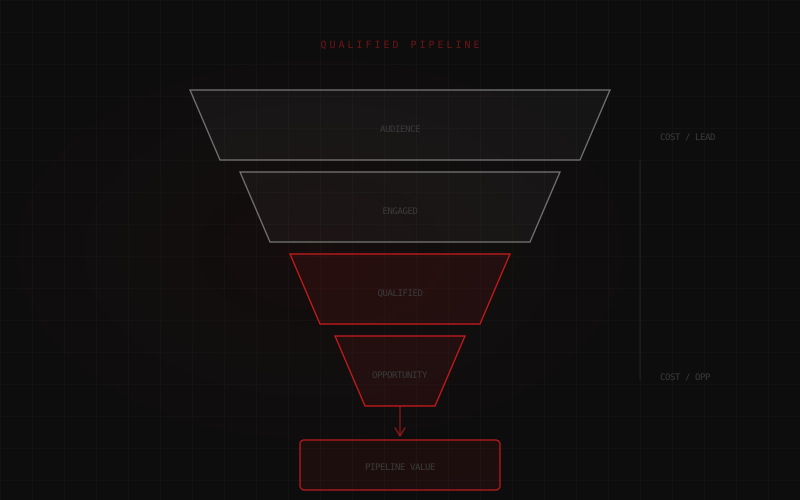
B2B Lead Generation Built Around Qualified Pipeline, Not Contact Volume
Lead generation programmes measured on volume fill a database. Programmes measured on qualified pipeline contribution fill a sales forecast. DAM Networks designs B2B lead generation around the ICP, the qualification criteria, and the commercial handoff, not the lead count.
High lead volume with low sales team conversion is not a sales performance problem. It is a lead quality problem.
Enterprise lead generation programmes are almost always measured on metrics that do not connect to the commercial number the business cares about. Cost per lead, volume by channel, and form conversion rate are activity metrics. They do not tell commercial leadership how much qualified pipeline the programme is producing or what it costs to generate a sales opportunity. That gap is where most B2B lead generation budget is consumed without attributable return.
CAPABILITIES
What DAM delivers across lead generation programmes
ICP Definition and Qualification Framework
Ideal customer profile development with the commercial and sales teams, lead scoring model design, and MQL-to-SQL handoff criteria that are agreed before lead generation begins. Prevents the retrospective disagreements that erode programme credibility.
Inbound Lead Generation
SEO, content, and paid media programmes designed to attract ICP-matched prospects and convert them through intent-matched offers. Landing page and conversion rate optimisation for lead capture against specific ICP intent signals.
Outbound Lead Generation
Account-based outreach, LinkedIn prospecting, and email sequences for organisations reaching ICP accounts that are not yet finding them through inbound channels. Designed around a specific trigger or signal, not a generic cold approach.
Pipeline Attribution and Reporting
CRM integration, pipeline stage tracking, and monthly reporting that attributes qualified opportunities and closed revenue to lead generation activities. Gives commercial leadership the data to make budget allocation decisions by channel.
DAM APPROACH
Lead generation programmes begin with a commercial brief from sales, not a channel plan from marketing.
Every engagement starts with a structured alignment session between marketing and sales: ICP in operational terms, qualification criteria for a marketing qualified lead, and the sales team's capacity to follow up. Lead generation programmes that produce more qualified leads than the sales team can act on are producing cost, not pipeline. Channel selection follows the ICP. Programme performance is reported at the pipeline level, not the lead level.
01
Sales Alignment Session
Every engagement starts with a structured session between marketing and sales, defining the ICP in operational terms and the qualification criteria for a marketing qualified lead.
02
Capacity and Handoff Criteria
The sales team's follow-up capacity and MQL-to-SQL handoff criteria are agreed before generation begins, because leads the team cannot act on produce cost, not pipeline.
03
Channel Selection and Launch
Channel selection follows the ICP, combining inbound programmes with account-based outbound designed around specific triggers rather than a generic cold approach.
04
Pipeline-Level Reporting
Programme performance is reported at the pipeline level, attributing qualified opportunities and revenue to activities so leadership can allocate budget by channel.
If lead volume is high but qualified pipeline contribution is not, the programme is generating the wrong leads. The fix starts with the ICP, not the channel.
DAM Networks designs B2B lead generation programmes for enterprise organisations where pipeline contribution is the primary metric. Engagements begin with ICP definition and sales-marketing alignment, not channel selection.
An MQL definition that works commercially combines firmographic fit (the organisation matches the ICP) with behavioural signal (the contact has demonstrated intent beyond passive awareness). Firmographic fit alone produces a list of target accounts with no purchase signal. Behavioural signal alone produces engaged contacts at organisations that will never buy. The specific criteria depend on the sales cycle length and the typical buying signals in the market: for high-ACV enterprise software, content download plus engagement with a product-specific page plus company size threshold is a common MQL framework. The definition should be agreed with the sales team before the programme begins, not after the first batch of leads converts poorly.
Volume depends on market size, ICP specificity, and channel budget. In a narrow B2B enterprise market where the ICP is a specific role at a specific type of organisation with a specific problem, a programme generating 20 to 40 qualified leads per month may be producing excellent pipeline coverage for a sales team of 5 to 10 people. Comparing to benchmark numbers from consumer or SMB markets misrepresents the commercial picture. The right target is derived from the sales team's capacity and the pipeline velocity required to hit the revenue target, not from an industry average.
Account-based marketing concentrates resource on a defined list of target accounts rather than generating leads from the market broadly. It is appropriate when the addressable market is small and well-defined, when average contract values are high enough to justify individualised marketing investment per account, and when the sales team operates with named account responsibility rather than territory or segment responsibility. ABM is not better or worse than broad lead generation. It is the right structure when the market and business model suit it. For most enterprise B2B organisations, a combination of broad inbound lead generation and targeted ABM for strategic accounts performs better than either in isolation.
We use cookies to improve this site.We use cookies to understand how the site is used and to improve it. You can accept all cookies or continue with only what is needed. See our Privacy Policy.