Performance Marketing

Your Paid Marketing Dashboard Is Showing Green. Your Pipeline Target Is Not.

Our performance marketing services start with the revenue model, not the platform. The reports come in every week. Impressions are up. Click-through rates are holding. Cost-per-click is within range. The paid media program, by every measure the platform produces, is working. Then the pipeline review happens. The number of qualified opportunities entering the funnel is below what the revenue plan requires.

The Problem

The Performance Marketing Reporting Gap

Most paid media programs report accurately. They report accurately on the things they were built to measure: reach, frequency, click volume, engagement rate, cost-per-click, and return on ad spend calculated against the last attributed click. None of those metrics tell the commercial team what it needs to know.

The question a CMO needs to answer is not what the cost-per-click was last month. It is how many qualified opportunities the paid program contributed to the pipeline, what those opportunities are worth, and whether the cost of generating them is consistent with the margin structure of the business. Platform metrics do not answer those questions. They answer a different set of questions about platform efficiency that matters to a media buyer but is largely irrelevant to a commercial leader.

The gap exists because most performance marketing programs are designed to optimize within the platform, not against the commercial objective outside it. Google Ads optimizes for conversions as defined by the conversion event the account is set up to measure. If that conversion event is a form submission, the program gets very good at producing form submissions. Whether those form submissions become qualified opportunities, and whether those opportunities are converting into revenue at the rate the business needs, is a question the platform does not and cannot answer on its own.

The structural consequence is that organizations often have paid programs running efficiently by platform standards while their cost per qualified lead is rising, their pipeline coverage ratio is deteriorating, and no one in the marketing team can produce a clear explanation of how the paid budget connects to the commercial target.

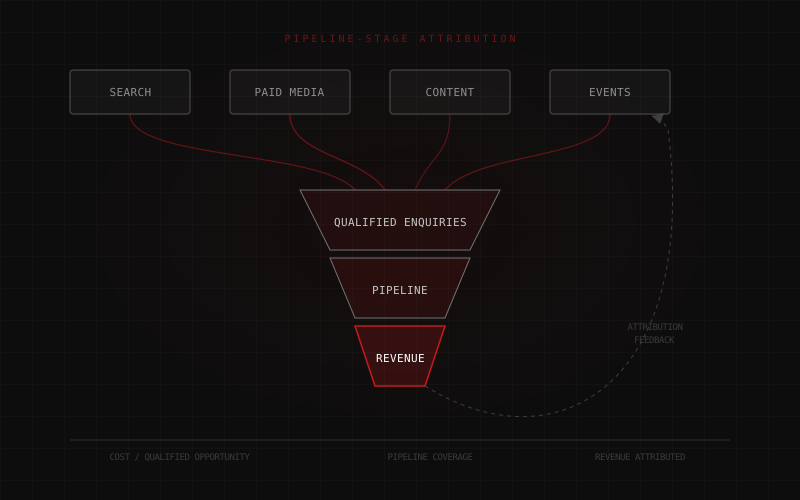
Resolving this gap requires two things: a measurement architecture that connects paid activity to pipeline stage and revenue outcome, and a program design that uses commercial objectives as the optimization target rather than platform proxies. The capability that makes this possible sits within data and analytics building the attribution model that connects spend to pipeline is foundational to a performance program designed for commercial accountability.


What DAM Delivers

What a Revenue-Accountable Performance Program Looks Like

A performance marketing program built around revenue accountability looks different from one built around platform optimization at every design stage.

Commercial Objective First

The design process begins with a specific commercial question: what pipeline volume is required this quarter, at what cost per qualified opportunity, to give the sales team the coverage it needs to close its revenue number. That question produces the constraints that govern every subsequent decision budget ceiling per qualified lead, minimum quality threshold, acceptable conversion rate assumptions at each funnel stage.

Targeting From ICP Definition

Platform audience tools are useful for execution, but the targeting logic should not begin inside the platform. The starting point is a precise definition of the ideal customer profile: the organizational characteristics, the buying role, the intent signals, and the stage in the buying cycle that make a prospect a qualified opportunity rather than an interested click. That definition is built from the commercial program, then translated into platform targeting parameters.

Creative for Conversion Intent

Creative for a performance program is designed to work at specific points in the buying journey, for specific audience segments, with specific commercial intent. The question is not whether the creative is on-brand. It is whether this creative, shown to this audience, at this stage of their evaluation process, produces the desired next action at a cost consistent with the commercial target.

Optimization Against Pipeline

When the measurement architecture connects paid activity to pipeline stage, the optimization feedback loop changes. Campaigns are evaluated and adjusted against cost per qualified opportunity, pipeline contribution by channel and campaign, and conversion rate from paid lead to pipeline stage. Campaigns that produce high click volume but low pipeline contribution are restructured or paused. Campaigns that produce fewer clicks but higher-quality pipeline are prioritized and scaled.

Platforms and Channels

DAM manages paid programs across Google Ads, Meta, LinkedIn, and programmatic. Channel selection follows from the audience definition and the commercial constraint, not from default configuration. The channel mix is an analytical output derived from where the ICP can be reached with sufficient precision at a cost the program can support.

Lead Generation Extension

For organizations where digital paid alone does not produce sufficient qualified pipeline at the required scale, lead generation services extend the program into structured outbound sequences and content-to-pipeline programs. This is particularly relevant for B2B organizations in niche markets where addressable audience size limits paid reach.

Ready to discuss your program?

Talk to Our Team

Engagement Model

How DAM Builds Performance Marketing Programs

Every performance marketing engagement begins with a commercial brief, not a platform audit.

01

Commercial Objective

Define pipeline volume per quarter, cost per qualified opportunity ceiling, and the revenue model those numbers are drawn from. This is not an aspiration. It is a constraint that governs the program design.

02

Audience Definition

Before any platform is accessed, the ICP is defined: organizational profile, buying role, decision-making structure, intent signals, and stage in the evaluation cycle. This definition is used to evaluate which platforms can reach the target audience with sufficient precision at a cost the program can support.

03

Channel Selection

The channel mix follows from the audience definition and the commercial constraint. Channel selection is an analytical output, not a default configuration. If the ICP is a VP of Operations at a mid-size manufacturing firm, the channel mix will look different than if the ICP is a practicing oncologist evaluating a specialty pharmaceutical product.

04

Creative Strategy

Creative is developed for specific audience segments and buying stages, evaluated against its expected contribution to the conversion sequence, and tested against commercial outcomes, not engagement metrics. Ad creative that produces high click-through rates but low pipeline conversion is not good creative for a revenue-accountable program.

05

Measurement Framework

The reporting architecture connects paid activity to pipeline stage from day one. The client has visibility into cost per qualified lead, pipeline contribution by channel and campaign, conversion rate by stage, and revenue attribution from paid programs. This is the reporting structure the program is managed against throughout the engagement.

Outcomes

Performance Marketing Results

From DAM performance marketing engagements. Each represents a different industry and a different primary commercial challenge.

58%

Reduction in cost per verified HCP inquiry

Pharma specialty product. HCP-targeted paid program rebuilt around specialist audience parameters, compliant creative for the specialist audience, and a measurement framework tracking verified HCP engagement rather than raw impressions. Total inquiry volume from qualified specialists increased 2.2x within the same budget over two quarters.

See case studies →

34%

Of new qualified opportunities from paid in year one

B2B capital equipment manufacturer. LinkedIn-led demand program targeting procurement, engineering, and operations decision-makers at target account profiles, combined with a content-to-pipeline sequence for mid-funnel prospects. Cost per qualified opportunity from paid was lower than the attributed cost per referral lead.

See case studies →

39%

Reduction in cost per qualified application

Financial services firm. Google Ads program restructured to target high-intent commercial queries, creative tightened to qualify out-of-profile visitors before the click, and a conversion value model implemented weighting qualified applications over total submissions. Internal review team's time spent on unqualified application review dropped proportionally.

See case studies →

FAQ

Frequently Asked Questions

What budget level is required to run a structured performance marketing program with DAM?

There is no fixed minimum, but the program design is meaningful only when the paid budget is sufficient to generate statistically reliable data within a reasonable optimization window. For most B2B paid programs, this means a monthly paid media budget of at least INR 3 to 5 lakhs enough to generate several hundred qualified clicks per month across the primary channels. Below that threshold, the data volume is too thin to optimize against commercial outcomes rather than platform proxies. The engagement fee for program design and management is separate from the media spend and scaled to the scope of the program.

How does DAM handle attribution when the sales cycle runs six to eighteen months?

Long sales cycles require an attribution model that tracks paid-influenced contacts through CRM stages rather than relying on last-click or last-touch attribution. DAM works with the client's CRM and marketing automation stack to build a pipeline-stage attribution model at the start of the engagement. This model connects the paid source of a contact to their progression through pipeline stages, so the reporting can show not just cost per lead but cost per qualified opportunity, cost per proposal stage, and paid influence on closed revenue even when the full cycle runs across multiple quarters.

How does DAM manage paid programs for pharma clients within regulatory constraints?

Pharma paid programs require the creative and targeting to be built within regulatory parameters from the brief stage, not reviewed against them after production. DAM's process for pharma clients includes: channel selection based partly on what the compliance function can approve for use in HCP-targeted promotion; creative briefing that builds in the approved messaging hierarchy and fair balance requirements from the outset; and program timelines that include MLR review cycles as a structural element, not a scheduling variable. The result is a paid program that is production-ready for regulatory submission rather than one that requires revision after the initial review.

For B2B lead generation, when should LinkedIn be prioritized over Google Ads?

The short answer is audience precision versus intent precision. Google paid search captures buyers with active commercial intent who are already evaluating solutions high intent, lower audience selectivity. LinkedIn allows precise targeting of specific job titles, seniority levels, company sizes, and industries high audience selectivity, lower intent signal. For B2B programs targeting a well-defined ICP in a market where buyers actively search for the solution category, Google paid search typically delivers lower cost per qualified lead. For programs where the ICP is narrow and buyers do not actively search because the solution category is new, complex, or not yet well defined as a search behavior LinkedIn targeting is usually the more efficient starting point. Most enterprise B2B programs use both in combination, sequenced by buying stage.

What does reporting look like during a performance marketing engagement, and how often does DAM report?

Reporting cadence and format are defined at the start of the engagement based on the client's internal reporting cycles. The standard structure includes a weekly operational report covering spend pacing, campaign performance, and any optimization actions taken; a monthly commercial performance report covering pipeline contribution, cost per qualified opportunity by channel and campaign, and conversion rates by funnel stage; and a quarterly program review covering commercial outcomes against the targets defined at the program start, with recommendations for the following quarter's program architecture. All reporting is organized around the commercial metrics the program was designed to produce, not platform dashboards.

Start Here

Start Your Program With the Commercial Number

The right way to evaluate a performance marketing program is not to ask what the click-through rate is. It is to ask how much qualified pipeline it produced last quarter, what that pipeline cost to generate, and whether that cost is consistent with the revenue model. If your current paid program cannot answer those questions clearly, the issue is program design, not budget.