INDUSTRIES · MANUFACTURING · B2B LEAD GENERATION

B2B Lead Generation for Industrial Manufacturers Where a Qualified Opportunity Takes Six Months to Develop

Industrial B2B lead generation is not a volume exercise. A manufacturer targeting 40 specific accounts in three sectors does not need 500 leads per month — it needs 40 multi-stakeholder relationships built over 12 to 24 months. DAM Networks designs lead generation programmes for industrial manufacturers calibrated to the scale, the sales cycle, and the buying committee of their market.

THE PROBLEM

Lead generation programmes designed for volume and speed do not fit the industrial procurement cycle.

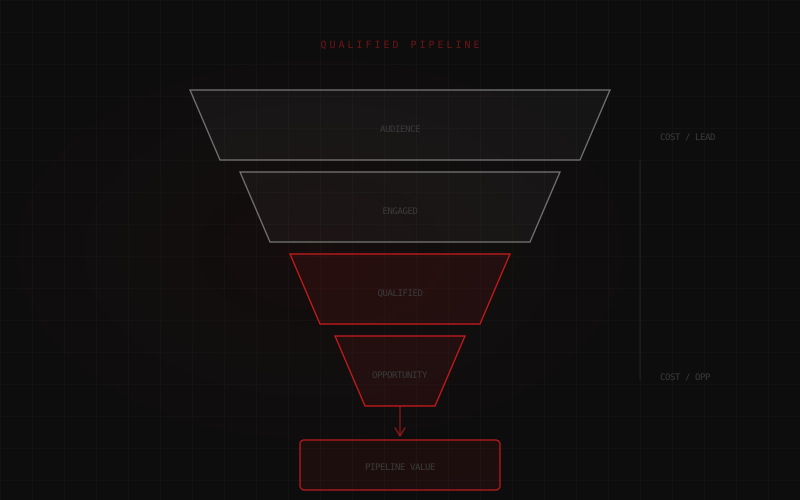
Industrial and manufacturing organisations that apply consumer or SaaS lead generation frameworks to their market generate leads that do not match the qualification criteria required for the sales team to progress them. A factory automation supplier cannot convert a contact who downloaded a white paper into a qualified opportunity without 12 months of relationship development, multiple site visits, technical evaluation, and committee-level approval. A lead generation programme that measures cost-per-lead without measuring cost-per-qualified-opportunity or cost-per-proposal is optimising for a metric that does not predict revenue in industrial markets.

The industrial procurement cycle requires a lead generation approach that mirrors the cycle's length and complexity. Lead qualification must account for the full buying committee — a single contact at a target account, however senior, does not constitute a qualified opportunity without coverage across the technical, financial, and operational stakeholder roles. Pipeline management must accommodate multi-year development periods without the lead scoring systems used in shorter-cycle markets classifying a contact as cold because they have not engaged in 90 days.

DAM Networks designs B2B lead generation programmes for industrial manufacturers where the qualification criteria, the nurture architecture, and the measurement framework are all calibrated to the length and complexity of the industrial procurement cycle — not to the metrics that work for SaaS or professional services markets.

CAPABILITIES

What DAM delivers across industrial B2B lead generation programmes

Target Account Identification and Profiling

Target account list development by sector, application, site profile, and capex cycle. Buying committee identification within target accounts — the technical, financial, and operational stakeholders who collectively make the procurement decision.

Outbound Prospecting and Development

Multi-channel outbound programmes combining direct outreach, LinkedIn engagement, trade show follow-up, and content-led nurture. Prospecting sequences designed for the 12 to 36-month development timelines of industrial capital procurement.

Inbound Lead Capture and Qualification

Specification-stage content that attracts technical evaluators during the early research phase. Lead capture mechanisms, qualification scoring calibrated to industrial buying signals, and routing to the appropriate sales resource based on account and opportunity profile.

Pipeline Measurement and Reporting

Pipeline stage reporting designed for long-cycle industrial markets — tracking opportunity progression over months rather than days. Measurement framework that reports on qualified opportunity development, proposal stage activity, and specification inclusion — not just lead volume.

DAM APPROACH

Industrial lead generation programmes begin with the target account list and the buying committee map — not the lead volume target.

The target account list is the starting point. For industrial manufacturers with a defined addressable market, the list of accounts that fit the ideal customer profile by sector, application, and scale is finite — often between 50 and 500 accounts. The lead generation programme is built around penetrating that list, not around generating high volumes of contacts from a broad audience. The qualification question is not whether a contact meets minimum lead criteria but whether the account they represent is on the target list and whether the contact has a role in the buying committee for the relevant procurement category.

Buying committee coverage is tracked at the account level. A target account where only one stakeholder has been identified and engaged does not represent a developed opportunity — it represents a single contact in an organisation where the procurement decision will involve multiple stakeholders. DAM tracks buying committee coverage as a pipeline metric: the percentage of target accounts where at least three of the four buying committee roles have been identified and engaged is a more reliable leading indicator of qualified opportunity development than lead count.

Specification-stage content is the most commercially important content category for industrial lead generation. Content that helps a technical evaluator understand how to solve a specific engineering or operational problem — before they have begun formally evaluating suppliers — positions the manufacturer as a technical partner rather than a vendor responding to a specification that someone else wrote. The commercial value of this positioning, in terms of specification influence and competitive displacement, significantly exceeds the commercial value of awareness content that reaches buyers after the specification has been written.

WORK WITH DAM NETWORKS

If the lead generation programme is producing contact volume but the pipeline is thin and the qualified opportunity development is slow, the programme is not designed for the industrial procurement cycle.

DAM Networks designs B2B lead generation programmes for industrial manufacturers. Engagements begin with the target account list and the buying committee map — not the lead volume target.

FREQUENTLY ASKED QUESTIONS

Questions about B2B lead generation for industrial manufacturers

Industrial capital equipment qualification criteria should be account-level rather than contact-level. A qualified account meets the ICP criteria: the right sector, application type, production scale, and capital expenditure profile for the product category. Within a qualified account, a qualified contact has a relevant role in the procurement decision — technical evaluator, plant manager, capex approver, or procurement. A contact at a qualified account with a relevant role who has engaged with specification-stage content or made direct contact represents a qualified lead. A contact who downloaded a white paper from an account that does not match ICP criteria is not a qualified lead regardless of their job title.

LinkedIn is most effective for industrial manufacturers for three specific uses: building awareness and credibility with target account stakeholders through thought leadership content and technical commentary; direct outreach to buying committee members at target accounts as part of an outbound prospecting sequence; and LinkedIn Sponsored Content targeting specific job functions at named accounts (LinkedIn's Company List targeting) for content distribution. It is less effective as a standalone lead generation channel for high-value capital procurement because the conversion from LinkedIn engagement to qualified industrial opportunity requires the additional steps of relationship development, site visits, and technical evaluation that LinkedIn advertising cannot accelerate. It should be part of a multi-channel programme, not the primary channel.

Trade shows remain a significant lead source for many industrial sectors because they concentrate the buying committee — technical evaluators, plant managers, and procurement professionals attend the same events and make time for supplier meetings that are harder to secure through outbound prospecting. The commercial value of trade show participation depends almost entirely on the pre-show and post-show programme rather than the stand itself. Pre-show outreach to target accounts already in the pipeline should secure meetings before the event opens. Post-show follow-up within 48 hours with a specific next step — a technical demonstration, a site visit, a proposal — converts the contact into a pipeline stage. Stands with no pre-booked meetings and no structured post-show follow-up generate badge scans, not opportunities.