Omnichannel Commerce That Behaves Like One Business, Not Three Channels Competing for the Same Customer
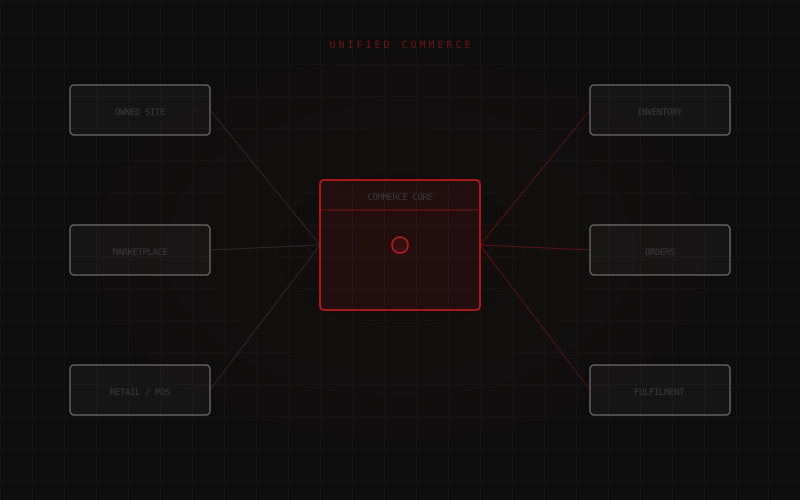
Customers do not distinguish between your website, your marketplace listings, and your stores. They see one brand quoting different prices, showing stock that is not there, and forgetting them at every channel boundary. DAM Networks builds omnichannel commerce operations where inventory, pricing, promotion, and customer identity are unified, so the channel a customer chooses stops determining the experience they get.
Most omnichannel programmes add channels without unifying the operations underneath them, and the customer pays the coordination cost.
Retail organisations typically build channels sequentially: stores first, then a website, then marketplaces, each with its own inventory logic, pricing authority, promotion calendar, and customer records. The result is structural, not accidental. A product shows in stock online because the system counts warehouse stock, not the store shelf. A promotion runs on the website but the store cannot honour it. The customer who bought in store is treated as a stranger online, and the loyal buyer is retargeted with acquisition offers. Each of these failures erodes margin or trust, and none of them is fixable at the channel level because the cause sits in the operating model. DAM Networks addresses the operating model first and the channel experiences second.
CAPABILITIES
What DAM delivers across omnichannel commerce
Inventory-Aware Commerce Experiences
Real-time stock visibility across warehouse, store, and marketplace channels, surfaced in the buying experience: accurate availability by location, realistic delivery promises, and store stock shown to online shoppers. What the customer is shown reflects what the business can actually fulfil.
BOPIS and Fulfilment Orchestration
Buy online pick up in store, ship from store, and return anywhere programmes, including the order routing logic, store operations workflow, and staff process design that determine whether these promises hold at volume rather than only in the pilot.
Pricing and Promotion Consistency
A single pricing and promotion governance model across owned site, marketplaces, and retail: who sets price, where channel-specific offers are permitted, and how conflicts are resolved before the customer discovers them. Promotion calendars are planned once and executed per channel.
Single Customer View and Activation
Identity resolution across store transactions, online accounts, and marketplace orders where the data permits, producing one customer record that drives recognition, service history, and marketing across channels. Loyalty and lifecycle programmes then act on the whole relationship, not one channel's slice of it.
DAM APPROACH
Unification is sequenced by commercial impact, starting where channel inconsistency is currently costing revenue or margin.
The engagement begins by quantifying the cost of the current fragmentation: cancelled orders from phantom inventory, margin lost to uncoordinated discounting, repeat customers acquired twice, and store traffic the online channel cannot see. That analysis produces a sequence, because no organisation should attempt inventory, pricing, and identity unification simultaneously. Each phase pairs a systems change with the operating change that makes it real: inventory accuracy work includes store counting discipline, BOPIS includes staffing and pick-time standards, and pricing consistency includes a decision-rights model that names who may discount what. Progress is reported in commercial terms, order cancellation rate, cross-channel repeat purchase rate, and contribution margin by channel, rather than integration milestones.
01
Fragmentation Cost Analysis
Quantify what the current fragmentation costs: cancelled orders from phantom inventory, margin lost to uncoordinated discounting, repeat customers acquired twice, and store traffic the online channel cannot see.
02
Impact-Led Sequencing
Turn that analysis into a phased sequence, starting where inconsistency is costing revenue or margin, because no organisation should attempt inventory, pricing, and identity unification simultaneously.
03
Paired Systems and Operations Change
Pair every systems change with the operating change that makes it real: inventory work includes store counting discipline, BOPIS includes staffing standards, pricing includes a decision-rights model.
04
Commercial Progress Reporting
Report progress in commercial terms, including order cancellation rate, cross-channel repeat purchase rate, and contribution margin by channel, rather than integration milestones.
If your channels report healthy numbers individually but customers who shop across them convert worse than single-channel buyers, the problem is the seams, not the channels.
DAM Networks unifies commerce operations in a sequence set by commercial impact. Engagements start with a fragmentation cost analysis across inventory, pricing, and customer data.
Usually not, and platform replacement is the wrong first move in most cases. The common failures, inaccurate availability, conflicting prices, disconnected customer records, are integration and governance problems that sit between systems rather than inside any one of them. The typical architecture keeps the existing platform and POS and adds an order management or inventory layer plus identity resolution on top. Replacement becomes the right answer only when the existing platform cannot expose the data or APIs the unified model needs, and that conclusion should come out of the assessment, not precede it. Sequencing this way also means commercial results arrive in months rather than after a multi-year replatform.
Pilots succeed because a motivated store with management attention can hide operational gaps that volume exposes. At scale, BOPIS fails on three things: store inventory accuracy, because an order routed to a store that miscounted its shelf becomes a cancellation; pick capacity, because stores staffed for walk-in traffic cannot absorb picking during peak hours; and accountability, because online orders belong to nobody's store targets. A durable programme sets an inventory accuracy threshold a store must meet before it receives orders, builds pick time into labour planning, and credits BOPIS revenue to the fulfilling store. These are operating decisions, and no software selection substitutes for them.
No, and pursuing identical pricing everywhere ignores real differences in channel economics: marketplace fees, store operating costs, and competitive dynamics differ by channel. What customers punish is not variation but incoherence, discovering in store that the same item is cheaper on your own website with no explanation or recourse. The workable standard is governed variation: a single pricing authority sets the base price and the permitted deviation by channel, channel-specific offers are framed as channel benefits rather than hidden discrepancies, and store teams are equipped to match or explain online prices. Consistency is a governance outcome, and it requires a named owner with authority across all channels.
We use cookies to improve this site.We use cookies to understand how the site is used and to improve it. You can accept all cookies or continue with only what is needed. See our Privacy Policy.