
Structured Team Composition
Engineering profiles assembled to the engagement's specific technical requirements, with a tech lead who owns the team's technical output and a delivery manager who owns the communication and reporting to the client side.
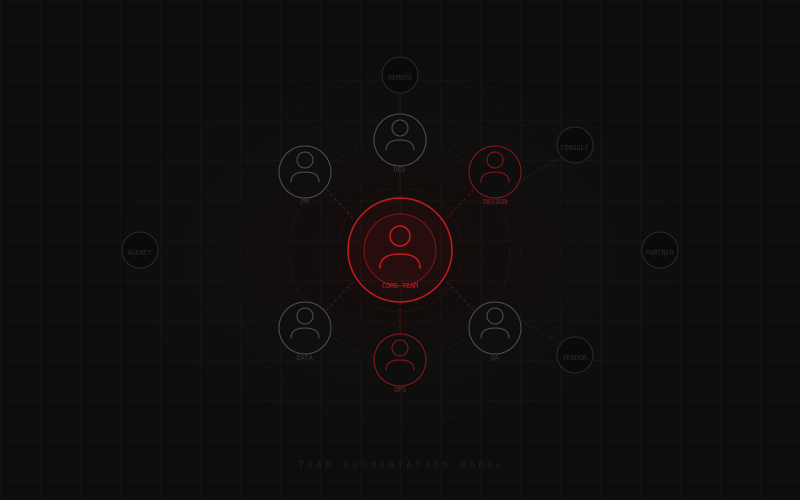
TEAM AUGMENTATION · REMOTE TEAM
The difference between a remote development team that delivers consistently and one that doesn't is rarely talent. It is structure. DAM Networks provides remote engineering capacity with the management overhead, communication protocols, and delivery accountability built into the service, not left to the client to construct.
THE PROBLEM
Enterprises that have attempted remote development teams and had poor experiences typically identify the same set of problems: communication lag across time zones, unclear accountability when deliverables slip, a single person on the remote team who holds all the project context and becomes a single point of failure, handoff failures when requirements change, and a gradual drift in work quality that is not detected until it is significant enough to cause a delivery incident. None of these problems require different engineers to fix. They require a different structure.
A remote development team requires the same structural elements as a co-located team, clear sprint ceremonies, documented technical standards, defined escalation paths, regular delivery reviews, and a management layer that is accountable for team performance, plus the additional protocols that distributed working requires: async communication norms, documentation standards that compensate for the absence of corridor conversations, and time zone overlap management that gives both sides adequate shared working hours.
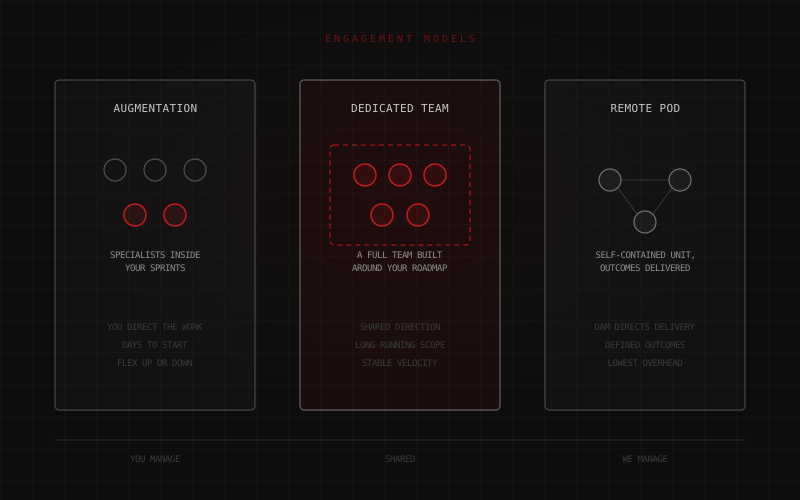
DAM Networks provides remote development teams with this structure as part of the service. The client manages the delivery backlog. DAM manages the team, its performance, its structure, its communication protocols, and its accountability to the delivery timeline. The client does not need to build remote team management capability internally to make the engagement work.
CAPABILITIES
Engineering profiles assembled to the engagement's specific technical requirements, with a tech lead who owns the team's technical output and a delivery manager who owns the communication and reporting to the client side.
Defined communication norms, documentation standards, daily async standups, and scheduled overlap hours that give the client team visibility into progress without requiring synchronous availability across all time zones.
Sprint commitments, velocity tracking, quality metrics, and weekly delivery reports that keep the client informed of progress and surface risks before they become delays. Accountability sits with DAM, not with the client to manage.
Architecture documentation, decision records, onboarding documentation, and codebase documentation maintained as living standards, not produced as a handover activity. Context is distributed across the team, not held by one person.
DAM APPROACH
Before the team composition is agreed, DAM works with the client to design the working model: time zone overlap requirements, sprint cadence, communication tools, definition of done, and the escalation path when issues arise. The working model is documented and agreed before the first engineer joins, not discovered through the friction of the first few sprints.
Time zone management is an explicit design decision, not an afterthought. DAM teams are composed with the client's location in mind, engineers placed to maximise the overlap window available for synchronous sessions, with async protocols covering the non-overlap hours. Clients in the UK or Europe working with DAM teams based in India or Southeast Asia typically have a four-to-six-hour overlap window that, when structured correctly, is sufficient for sprint ceremonies and daily coordination without requiring either side to work outside normal hours at scale.
Monthly engagement reviews cover delivery velocity, quality metrics, and working model friction. Working model problems, communication gaps, ceremony effectiveness, documentation quality, are addressed in the review, not left to accumulate until they cause a delivery incident. The review is as important as the sprint review for maintaining the quality of a remote engagement over time.
RELATED SERVICES
Prefer to see outcomes first? Review documented engagements and the results they produced in our case studies.
WORK WITH DAM NETWORKS
DAM Networks provides remote development teams with management structure, communication protocols, and delivery accountability built into the service. The working model is designed before the first engineer joins.
FREQUENTLY ASKED QUESTIONS
A minimum of three hours of real overlap, where both teams are in normal working hours simultaneously, is sufficient for daily coordination and sprint ceremonies when the async communication protocols are well-designed. Four to six hours is comfortable and allows for more fluid collaboration on complex technical problems. Less than three hours requires a heavily async working model where most collaboration happens through documentation and recorded walkthroughs rather than live sessions, which is workable but requires more discipline from both sides to maintain.
Knowledge concentration in a single person is a structural failure, not a personality failure. It happens when documentation is treated as optional, when code review is not enforced as a practice, and when the team's communication happens predominantly in private messages rather than shared channels. DAM's working model requires architecture decision records for all significant technical decisions, mandatory code review with a minimum two-reviewer policy, shared knowledge bases for domain context, and sprint retrospectives that explicitly surface knowledge concentration risks as a standing agenda item.
All code, documentation, and architecture records produced during the engagement belong to the client from the first commit. The documentation standards built into DAM's working model mean that the codebase is accompanied by architecture documentation, decision records, and onboarding guides that allow a new team, internal or external, to take over the codebase without a prolonged knowledge transfer process. Engagement wind-downs include a 90-day notice period and a structured handover programme covering any remaining context that is not already documented.