APIs Designed as Products, Not Plumbing Between Systems
An API is a contract that other teams, partners, and customers build against. When it is treated as an integration afterthought, every change becomes a breaking change and every consumer becomes a liability. DAM Networks designs, builds, and governs APIs with the same discipline applied to any commercial product: defined consumers, versioned contracts, and a measurable developer experience.
Most enterprise APIs were built to serve one integration and are now serving twenty.
APIs typically start life as internal shortcuts: an endpoint built to connect two systems for one project, with the contract implied by whatever the first consumer needed. Years later that same endpoint carries partner integrations, mobile applications, and revenue-bearing customer workloads, and nobody can change it without breaking something they cannot see. There is no version strategy, no consumer inventory, no documentation a new integrator could actually use, and no way to answer the question of who calls what. The cost surfaces as stalled projects, because every new initiative that touches the API layer inherits the accumulated fragility. DAM Networks treats the API layer as an asset with an owner, a roadmap, and a governance model, not as connective tissue that nobody is responsible for.
CAPABILITIES
What DAM delivers across API development and governance
API Design and Contract Definition
Specification-first design using OpenAPI or GraphQL schemas, with the contract reviewed against consumer needs before implementation begins. Naming, error semantics, pagination, and authentication patterns are standardised so every API in the estate behaves the same way.
Build, Versioning, and Lifecycle Management
Implementation of REST, GraphQL, and event-driven APIs with an explicit versioning policy: what constitutes a breaking change, how deprecation is communicated, and how long old versions are supported. Consumers are never surprised by a release.
Integration Architecture
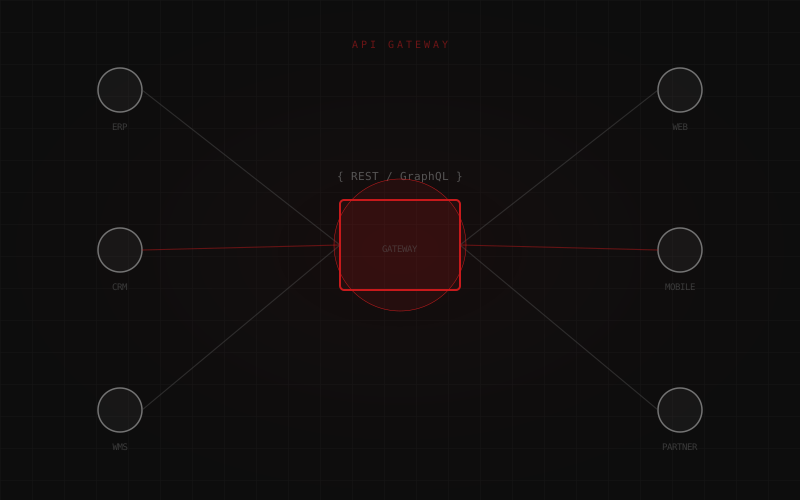
Gateway selection and configuration, rate limiting, authentication and authorisation design, and the integration patterns that connect APIs to ERP, CRM, and legacy systems. The architecture is documented so the next team can extend it without archaeology.
Developer Experience and Governance
Reference documentation, sandbox environments, SDK generation, and onboarding paths measured by time to first successful call. Governance covers consumer inventory, usage analytics, and design review so the API estate stays coherent as it grows.
DAM APPROACH
API work begins with a consumer inventory, not an endpoint list.
Before designing or refactoring anything, DAM establishes who consumes the API layer today, what they depend on, and what the intended consumer set looks like in two years, because those answers determine the contract design, the versioning policy, and the governance weight the estate justifies. Contracts are specified and reviewed before code is written, so implementation debates happen on a document rather than in production. Every API ships with the operational package a real consumer needs: documentation tested against a new integrator, monitoring on latency and error rates per consumer, and a deprecation process that has actually been rehearsed. Success is measured in consumer terms: time to first integration, change failure rate at the API boundary, and the number of projects the API layer accelerates rather than blocks.
01
Consumer Inventory
Establish who consumes the API layer today, what they depend on, and what the intended consumer set looks like in two years before designing or refactoring anything.
02
Contract-First Design
Specify and review contracts before code is written, so implementation debates happen on a document rather than in production, along with versioning policy and governance weight.
03
Operational Packaging
Ship every API with documentation tested against a new integrator, monitoring on latency and error rates per consumer, and a rehearsed deprecation process.
04
Consumer-Term Measurement
Measure success in consumer terms: time to first integration, change failure rate at the API boundary, and the number of projects the API layer accelerates.
If every project that touches your API layer takes longer than the project itself, the integration layer has become the constraint on delivery.
DAM Networks builds and governs API estates that other teams can build against with confidence. Engagements start with a consumer inventory and an assessment of the current contract landscape.
The answer depends on who consumes the API and how, not on technology preference. REST remains the right default for partner-facing and public APIs because tooling, caching, and integrator familiarity are strongest there. GraphQL earns its complexity when a small number of frontend teams need flexible queries over a wide data model, and it costs more in caching, authorisation design, and performance governance than teams expect. Event-driven APIs suit workflows where consumers need to react to state changes rather than request data on demand. Most enterprise estates end up with a deliberate mix, and the important decision is documenting when each style applies so the estate does not accumulate all three by accident.
The first step is establishing a consumer inventory, because you cannot safely change a contract without knowing who depends on it, and most organisations discover consumers they did not know existed. From there the standard pattern is to place a gateway or facade in front of the legacy endpoints, publish the new contract behind it, and migrate consumers in cohorts while the old contract continues to operate. Traffic analytics tell you when a legacy version is genuinely unused and can be retired, rather than guessing. The migration is a communications programme as much as an engineering one: consumers need notice, a migration guide, and a support channel. Done this way, modernisation happens without a single coordinated cutover event and without breaking production integrations.
In practice, governance is four things: design standards so every API behaves consistently, a review step before new contracts are published, a consumer registry so change impact is knowable, and usage analytics so decisions about deprecation and investment are based on data. The right amount of governance scales with the consumer base. An internal API with two known consumers needs a design standard and little else, while a partner-facing API carrying revenue needs formal versioning policy, published deprecation timelines, and service level commitments. The failure mode to avoid is governance theatre: heavyweight review boards that slow delivery without improving contract quality. Governance should make the next integration faster, and if it does not, it is miscalibrated.
We use cookies to improve this site.We use cookies to understand how the site is used and to improve it. You can accept all cookies or continue with only what is needed. See our Privacy Policy.