
PPC Management
The PPC Program Is Optimized. The Pipeline Target Is Still Not Being Met.
The campaign manager's dashboard tells one story. Impression share is climbing. Quality scores are solid. Cost-per-click is within benchmark. The account, by the metrics the platform surfaces, is being managed well.
The commercial review tells a different story. Leads from paid search are not converting into qualified opportunities. The sales team is working through inquiries that should never have been generated. The pipeline contribution from search is below what the revenue plan requires, and the gap is not closing despite rising ad spend.
This is the PPC optimization trap. DAM Networks designs PPC programs from the commercial objective outward. The question that governs every design decision is not what the platform can optimize. It is what volume of qualified pipeline needs to be generated from search, at what cost per qualified lead, from which audience segments expressing which intent signals.
The Problem
What Separates a Pipeline-Generating PPC Program From a Traffic-Generating One
The difference is not budget. It is not the number of campaigns or the sophistication of the bidding strategy. It is what the program was designed to produce.
A traffic-generating PPC program is designed to put visitors on the website at the lowest possible cost-per-click. Success looks like volume: sessions, clicks, impressions. The program is optimized for acquisition metrics that measure how cheaply attention was purchased. What happens after the click is treated as a separate problem.
A pipeline-generating PPC program is designed to put the right visitors in front of a conversion experience that qualifies and captures them as potential buyers. Success looks like qualified leads, qualified meetings, and pipeline stage progression. Every element: keyword selection, match type logic, negative keyword strategy, ad creative, bidding, and landing experience: is evaluated against its contribution to commercial outcomes.
Keyword strategy in a traffic-generating program starts with volume. Keyword strategy in a pipeline-generating program starts with intent: which searches indicate that the person conducting them is in active commercial evaluation, not general research or casual interest. A pharmaceutical company targeting oncologists does not need every search that includes a drug name. It needs searches from practitioners who are evaluating treatment options: different keywords, often lower-volume, requiring a different selection logic.
Negative keyword strategy in most accounts is an afterthought. Attribution in a traffic-generating program stops at the form submission. In a pipeline-generating program, it connects the search query to the lead, the lead to the opportunity stage, and the opportunity stage to the revenue outcome.
This is the difference performance marketing programs built around commercial accountability produce in search advertising: the same platform, the same budget range, and a structurally different commercial outcome.
What DAM Manages
What DAM Manages Across PPC
Every element of the paid search program managed against a commercial objective: qualified pipeline from search intent, at a defined cost per qualified lead.
Google Search
Search campaign architecture built around commercial intent signals, not keyword volume. Campaigns separate intent tiers high-intent commercial queries, mid-funnel evaluation queries, and brand-adjacent queries so budget is allocated against the intent signal most likely to produce qualified pipeline. Match type logic controls which search behaviors trigger the campaign, not to maximize reach. See our full Google Ads management capability.
Google Shopping
For product-led B2B categories, Shopping campaigns are structured around product-level commercial intent: searches that indicate a buyer is evaluating specific product specifications, comparing vendors, or preparing a procurement decision. Feed management, product segmentation, and bidding prioritize pipeline-adjacent searches over general product browsing.
Display and Remarketing
Display programs within a PPC engagement serve a specific pipeline function: maintaining commercial presence with audiences who have expressed search intent but have not yet converted. Display is not a reach investment in a pipeline-generating program. It is a precision instrument for staying in view with high-probability prospects between search interactions.
Microsoft Advertising (Bing)
Microsoft Search carries a disproportionate share of enterprise and professional audience search volume. For B2B organizations targeting senior buyers, finance professionals, or healthcare practitioners, the Bing audience skews older, more senior, and more enterprise-oriented. DAM manages Google and Bing as components of a unified paid search program governed by the same commercial objective.
Negative Keyword Strategy
Systematic exclusion of non-converting search terms is one of the highest-return activities in paid search management. DAM manages negative keywords as a continuous program: reviewing search term reports against pipeline conversion data, identifying query patterns that consume budget without producing qualified pipeline, and expanding the negative list across campaigns. The compounding effect improves both cost per lead and lead quality over the life of the program.
Conversion Tracking and Attribution
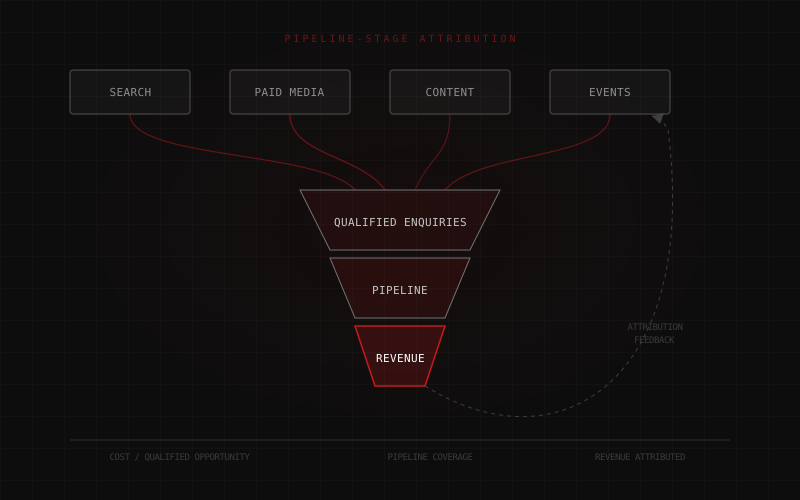
Conversion tracking connected to the CRM and pipeline produces commercial accountability data. DAM establishes the conversion tracking architecture at the start of every engagement: the events to track, the values assigned by pipeline stage probability, and the CRM connection that allows paid search leads to be followed through the commercial pipeline. For organizations without internal conversion rate capability, marketing automation work can be brought in as a component of the engagement.
Ready to discuss your paid search program?
Talk to Our TeamHow It Works
How DAM Structures PPC Engagements
Every paid search engagement begins with a commercial objective, not a platform audit.
Commercial Objective and Pipeline Target
The first conversation defines what the PPC program needs to deliver: qualified pipeline volume per quarter, cost per qualified lead ceiling, and the revenue contribution model those numbers sit within. This is the constraint that governs every subsequent decision in the program.
Audience and Intent Mapping
Before campaigns are built or restructured, the audience segments and intent signals the program is targeting are defined explicitly. Which queries indicate active commercial evaluation? Which look related but will not produce a qualified lead? This mapping produces the keyword strategy, match type logic, and negative keyword foundation that the campaign structure is built on.
Campaign Architecture and Landing Experience
The account and campaign structure is designed to separate intent tiers, allocate budget against commercial priority, and produce data organized by commercial relevance rather than platform convenience. The landing experience for each audience segment is reviewed against conversion rate data. Gaps between click and conversion are identified and sequenced into the program plan. The PPC engagement connects to the broader performance marketing program and to growth marketing practice. SEO services can be discussed alongside the PPC brief.
Measurement and Pipeline Attribution
The reporting framework connects paid search activity to pipeline stage. The client has visibility into cost per qualified lead by campaign and intent tier, pipeline contribution from paid search by month, and conversion rate from paid search lead to opportunity stage. Platform-level metrics are tracked as diagnostics, not success criteria.
Industries
Where DAM Runs PPC Programs
Pharmaceutical and Healthcare
Search programs for pharmaceutical organizations require compliance architecture built into the campaign before any ad goes live. HCP-targeted search campaigns must use approved messaging and operate within channel restrictions that apply to the product category. DAM structures pharma PPC programs with regulatory requirements as design constraints from brief to launch, not as a review layer applied after production. See Pharma and Healthcare for the full scope of DAM's capability.
Manufacturing
B2B industrial search programs have a narrow addressable audience and a high cost-of-error for unqualified traffic. Search programs for manufacturing clients are built around the query patterns that indicate active procurement intent, with targeting parameters and negative keyword architecture designed to restrict ad delivery to searches with a realistic probability of producing a qualified inquiry. See Manufacturing for sector context.
Financial Services
Regulated financial product search programs require message architecture that meets disclosure requirements without reducing commercial clarity. In financial services PPC, program efficiency is determined primarily by how precisely the program reaches the right audience at the right intent stage. Broad reach with compliant-but-generic messaging produces expensive, low-converting traffic.
Real Estate
Property search programs have a commercial structure defined by launch windows and inventory absorption targets. PPC for real estate developers is designed around the pre-launch and launch calendar: building search presence ahead of the launch date and concentrating qualified inquiry volume in the peak sales window. See Real Estate for launch campaign program context.
Outcomes
Paid Search Outcomes
The following results are from DAM PPC engagements. Each represents a different industry, a different primary commercial challenge, and a different performance lever.
51%
Reduction in cost per qualified meeting
B2B technology services firm. Restructured broad-match campaigns around high-intent commercial queries with rigorous negative keyword management and a conversion sequence designed for the ICP. Cost per qualified meeting dropped 51% over two quarters. Qualified meetings per month increased 40% within the same total budget.
2.7x
Increase in compliant patient inquiry volume
Specialty pharmaceutical company. Patient-facing indication with low public awareness. Campaign rebuilt around symptom-related and condition-awareness queries within the approved messaging framework. Compliant patient inquiry volume increased 2.7x over the previous program in the same period.
28%
Incremental qualified pipeline from Bing integration
Industrial equipment manufacturer. Bing program structured with the same campaign architecture and intent segmentation as the Google account contributed 28% incremental qualified pipeline in the first six months at a cost per qualified lead 19% lower than the Google program average.
FAQ
Frequently Asked Questions
There is no fixed minimum, but the program design produces meaningful commercial data only when the budget generates sufficient qualified click volume to make optimization decisions against pipeline outcomes rather than platform proxies. For most B2B paid search programs, this means a monthly media spend of at least INR 2 to 4 lakhs on the paid search side enough to generate several hundred commercially relevant clicks per month across primary intent tiers. Programs with budgets below that threshold can still be structured for commercial accountability, but the optimization cycle is slower because the data accumulation rate is lower. The program management fee is separate from media spend.
Microsoft Search consistently carries a higher proportion of enterprise, finance, healthcare, and senior professional audience traffic than its overall market share would suggest. For B2B programs targeting procurement leaders, financial professionals, healthcare practitioners, or government buyers, the Bing audience is a meaningful commercial segment that Google Search does not fully reach. The decision to allocate budget to Bing should be based on an analysis of where the target ICP actually searches, not on platform market share as a default. For organizations whose customers skew toward Windows enterprise environments, government contracts, or senior professional roles, Bing frequently produces a lower cost per qualified lead than Google on the same intent tiers.
Pharma PPC compliance is built into the program architecture before a campaign goes live, not reviewed after it is built. The keyword strategy is reviewed against what can be promoted in the specific product category. Creative is briefed with the approved messaging hierarchy from the outset, with fair balance and regulatory requirements incorporated before the MLR submission, not added during revision. Landing pages are reviewed for compliance with promotional communication standards applicable to the product and audience. The program timeline includes MLR review cycles as a structural scheduling element. The result is a search program that is production-ready for regulatory submission rather than one that requires a compliance retrofit after launch.
They address different commercial problems and running both typically produces better commercial outcomes than either alone. PPC captures high-intent search demand immediately fast to activate, fast to adjust, and directly attributable to pipeline within weeks. SEO builds structural cost-per-acquisition advantage over time. The case for running both is that PPC fills the pipeline while the organic program is building, and as organic begins contributing pipeline at lower cost, the PPC program can be restructured to focus on the highest-value intent segments. The programs should share keyword strategy and conversion tracking architecture. Running them in isolation, with different agencies and separate data environments, produces competitive waste and attribution confusion. SEO services can be scoped alongside a paid search engagement.
Long B2B sales cycles require an attribution model that tracks paid search influence through pipeline stages rather than assigning all commercial credit to the last-touch conversion event. DAM establishes a pipeline-stage attribution model at the start of every engagement: the paid search source is captured at first contact, connected to the CRM record, and followed through each pipeline stage. This produces reporting that shows cost per qualified lead, cost per opportunity, cost per pipeline stage by source, and paid search influence on closed revenue even when the sales cycle runs six to eighteen months. This architecture is set up before campaigns launch, because retrofitting attribution into an existing CRM and analytics stack after the fact produces incomplete historical data.
Get Started
Define the Pipeline Objective Before the Campaign
PPC managed for platform efficiency produces platform results. PPC managed for commercial outcomes produces pipeline. The gap between those two versions of the same channel is a program design gap, not a platform feature gap. That is what DAM builds.
For the broader paid media program context, see performance marketing and growth marketing. For related capability, see Google Ads management, LinkedIn advertising, and lead generation services.