Enterprise Modernization That Keeps the Business Running While the Systems Underneath It Change
Legacy systems rarely fail loudly. They fail by making every change expensive, every integration fragile, and every hiring search harder. DAM Networks modernizes core systems incrementally, replacing capability by capability while the existing system keeps serving the business, so operations never depend on a single high-risk cutover weekend.
The big-bang rewrite is the most expensive way to discover what the legacy system actually did.
Organisations tolerate ageing core systems for years, then attempt to escape in a single project: rewrite everything, migrate everything, cut over on one weekend. These programmes routinely run multiples over budget because the legacy system encodes decades of business rules that no document describes, and each undocumented rule is rediscovered as a production defect after cutover. Meanwhile the business freezes change requests for the duration, so the rewrite ships already behind the requirements it was meant to satisfy. The data migration compounds the risk, because records shaped by twenty years of workarounds rarely fit the new schema cleanly. DAM Networks takes the opposite path: modernize in slices, run old and new in parallel, and retire the legacy system only after each replaced capability has proven itself in production.
CAPABILITIES
What DAM delivers across enterprise modernization programmes
Legacy Assessment and Modernization Sequencing
A capability-level map of the legacy estate: which functions carry business risk, which block change, and which can safely remain. The output is a sequenced modernization plan ordered by risk reduction and business value, not by technical preference.
Incremental Replacement Using Strangler Patterns
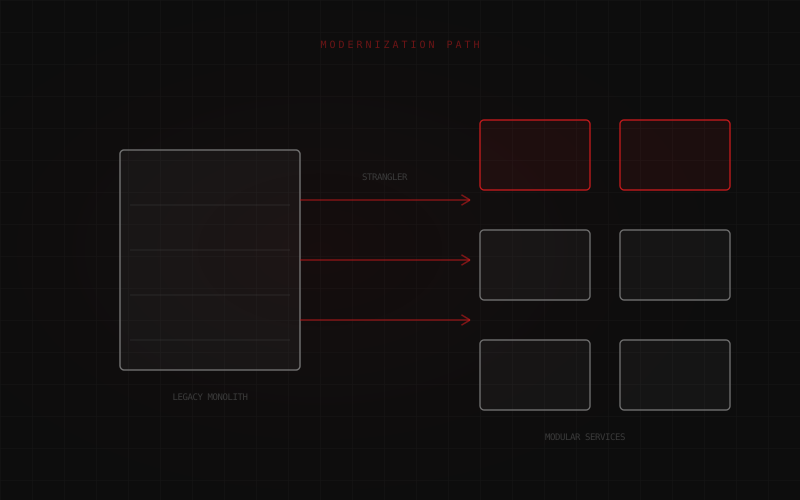
New capabilities built alongside the legacy system behind a routing layer, with traffic shifted gradually and reversibly. Each slice goes live independently, and the legacy function is decommissioned only after the replacement has carried production load.
Data Migration With Verified Integrity
Migration treated as a data quality programme: profiling before mapping, reconciliation counts and business-rule validation on every run, and rehearsal migrations executed until the discrepancy report is explainable line by line before any production move.
Operational Continuity and Cutover Management
Parallel-run design, rollback procedures, staff training on the new workflows, and hypercare support after each transition. Every cutover has a tested path back, and the business signs off on continuity criteria before traffic moves.
DAM APPROACH
Modernization is sequenced by business risk, delivered in reversible steps, and proven in production before anything is switched off.
DAM begins by mapping the legacy estate at the level of business capability rather than codebase, because the decision of what to modernize first belongs to risk and value, not to which module is oldest. Replacement then proceeds in slices behind a routing layer: each new component takes a share of production traffic, runs in parallel with the legacy function, and is reconciled against it until the outputs match. Data moves the same way, with rehearsal migrations and reconciliation reports rather than a single conversion event. The legacy system is retired capability by capability, which means the programme delivers value from the first slice, the business never freezes, and at no point does the organisation bet its operations on one weekend going perfectly.
01
Capability-Level Estate Mapping
Map the legacy estate at the level of business capability rather than codebase, sequencing what to modernize first by risk and value, not by which module is oldest.
02
Parallel Slice Replacement
Replace in slices behind a routing layer. Each new component takes a share of production traffic and runs in parallel with the legacy function.
03
Reconciliation and Data Migration
Reconcile new components against legacy outputs until they match, moving data through rehearsal migrations and reconciliation reports rather than a single conversion event.
04
Staged Legacy Retirement
Retire the legacy system capability by capability, with tested rollback and continuity sign-off, so operations never depend on one weekend going perfectly.
RELATED SERVICES
Services that work alongside Enterprise Modernization
If the core system can only be changed by the two people who remember how it was built, the modernization decision has already been made. Only the timing is open.
DAM Networks modernizes enterprise systems in reversible increments, with data integrity verified at every step and the business running throughout. Engagements start with a legacy assessment and a sequenced plan.
A strangler pattern places a routing layer in front of the legacy system and replaces its functions one at a time, directing traffic for each replaced capability to the new component while everything else continues to run on the old system. The legacy system is gradually reduced until nothing depends on it and it can be retired. The pattern is preferred because it converts one enormous, irreversible risk into a series of small, reversible ones: each slice can be tested against real production behaviour, rolled back if it misbehaves, and paid for by the value it delivers. It also surfaces the undocumented business rules embedded in the legacy code slice by slice, while there is still a working reference system to compare against, instead of discovering them as defects after a full cutover.
Integrity is protected by treating migration as a measured process rather than a one-time conversion. Source data is profiled first, because decades of workarounds leave records that violate the assumptions any new schema makes, and those anomalies must be catalogued and given explicit handling rules before mapping begins. Every migration run produces reconciliation output: record counts, financial totals, and business-rule checks compared between source and target, with each discrepancy explained rather than waved through. Rehearsal migrations repeat until the reconciliation report is clean or every remaining variance is documented and accepted by the business owner of the data. Only then does a production migration run, and the same reconciliation executes again before the new system is declared authoritative.
Continuity is a design requirement, not a hope. Because replacement happens in slices, the legacy system remains fully operational for everything not yet migrated, and each transition affects one capability with a tested rollback path behind it. Parallel-run periods let the old and new components process the same transactions while outputs are reconciled, so problems appear in a comparison report rather than in front of a customer. Cutovers are scheduled around the business calendar, staff are trained on each new workflow before their function moves, and a hypercare window follows every transition with the delivery team on call. The business defines the continuity criteria for each slice in advance, and traffic does not move until those criteria are signed off.
We use cookies to improve this site.We use cookies to understand how the site is used and to improve it. You can accept all cookies or continue with only what is needed. See our Privacy Policy.