LinkedIn Advertising Managed for Lead Quality and Pipeline Contribution, Not Click Volume
LinkedIn is the most expensive major advertising channel per click, and for a specific job: reaching a defined B2B buyer profile in a cold audience with precision no other platform matches. DAM Networks manages LinkedIn campaigns where the targeting spec, the offer, and the qualification threshold are designed to justify that cost per lead against pipeline value.
LinkedIn campaigns run with broad targeting and generic offers pay premium CPMs for an audience that could have been reached cheaply elsewhere.
LinkedIn CPMs commonly run three to eight times higher than Meta for comparable reach, which means the channel only makes commercial sense when its professional targeting is doing work no other platform can. Most enterprise LinkedIn accounts do not use it that way: audiences are defined loosely, the same content-download offer runs to every seniority level, and success is reported in clicks and form fills rather than in leads that survived sales qualification. The finance question that follows is predictable: why is this channel three times the cost per lead of everything else. The defensible answer requires targeting built on job function, seniority, and account lists, and reporting built on qualified pipeline. Without both, LinkedIn is simply an expensive display network.
CAPABILITIES
What DAM delivers across LinkedIn advertising engagements
Audience Architecture and Targeting Design
Audience builds from job function, seniority, company size, and industry combinations validated against the ICP, matched audience uploads from CRM and account lists, and exclusion logic to keep spend off existing customers, competitors, and non-buying roles.
ABM Integration and Account Targeting
Company-list campaigns aligned to the account-based marketing programme, with creative and offers sequenced by account tier and buying stage, and engagement data fed back to sales so account owners see which target accounts are consuming the campaign.
Offer Strategy and Creative Development
Offer design matched to seniority and stage: research and benchmark content for cold senior audiences, evaluation-stage assets for engaged accounts, and direct consultation offers only where intent signals justify them. Creative tested against qualified lead cost, not click-through rate.
Lead Qualification and Pipeline Reporting
Lead Gen Form and landing page conversion tracking connected to the CRM, qualification outcome tracked per campaign and audience, and monthly reporting on cost per qualified lead and pipeline contribution alongside the platform metrics.
DAM APPROACH
LinkedIn is assigned the work only it can do: precise cold-audience prospecting and named-account coverage. Everything else moves to cheaper channels.
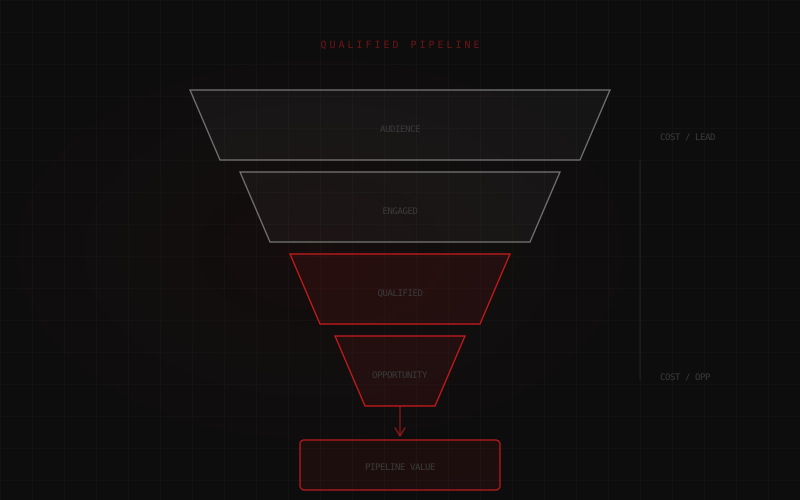
Channel allocation comes before campaign build. LinkedIn takes cold prospecting against defined professional profiles and ABM account coverage, where its targeting precision is worth the premium. Retargeting of identified audiences moves to Meta and programmatic channels at a fraction of the CPM, and active-intent capture stays with paid search. Within LinkedIn, campaigns are structured by audience tier and buying stage, offers are matched to seniority, and every lead is tracked through sales qualification so the channel is judged on cost per qualified lead and pipeline contribution over the sales cycle, not on the week's form-fill count. Budgets are rebalanced monthly against those qualified numbers.
01
Channel Role Allocation
Assign LinkedIn only the work it can do: cold prospecting against defined professional profiles and ABM account coverage. Retargeting moves to Meta and programmatic, intent capture stays with paid search.
02
Audience and Campaign Structure
Structure campaigns by audience tier and buying stage, built from job function, seniority, company size, and account lists, with exclusion logic keeping spend off non-buying roles.
03
Offer and Creative Matching
Match offers to seniority and stage: research content for cold senior audiences, evaluation assets for engaged accounts, and consultation offers only where intent signals justify them.
04
Qualified Lead Measurement
Track every lead through sales qualification so the channel is judged on cost per qualified lead and pipeline contribution, with budgets rebalanced monthly against those numbers.
If LinkedIn is the most expensive line in the paid media budget and nobody can show its cost per qualified lead against pipeline value, the channel is being run on the wrong metrics.
DAM Networks manages LinkedIn advertising for enterprise B2B organisations. Engagements begin with an audit of the audience architecture, offer strategy, and qualified lead economics.
Questions about LinkedIn advertising for enterprise B2B
LinkedIn CPCs commonly range from 5 to 15 dollars and can exceed 20 dollars for senior audiences in competitive categories, against 1 to 3 dollars on Meta for broad reach. The premium buys targeting data no other platform holds at that accuracy: current job title, function, seniority, company, and industry. That is worth paying for when the buyer is a narrow professional profile, the deal value is high, and cheaper channels cannot isolate the audience without heavy waste. It is not worth paying for retargeting audiences that Meta can reach for a fraction of the cost, or for broad awareness objectives. The economic test is simple: if average deal value and conversion rates support a cost per qualified lead of 150 to 500 dollars or more, LinkedIn prospecting is usually viable; if the model needs 30 dollar leads, it is the wrong channel.
Lead Gen Forms pre-populate from the member's profile and typically cut cost per lead by 20 to 50 percent versus landing pages, with the added benefit of accurate professional data. The tradeoff is intent: the low friction means a share of submissions come from people who barely registered what they signed up for, so downstream qualification rates are usually lower. Landing pages filter for intent but raise cost per lead and lose some data accuracy to self-typed fields. The practical answer depends on what happens after the form: if leads enter a nurture programme with scoring before sales contact, Lead Gen Forms usually win on blended economics; if leads route directly to sales, the higher-friction landing page protects sales time. Many programmes run both and let qualified-lead cost decide the split.
With CPCs of 5 to 15 dollars and typical B2B conversion rates of 1 to 3 percent on cold audiences, meaningful testing requires enough volume to read results: in practice a working floor of roughly 5,000 to 10,000 dollars per month for a single-market programme, and materially more for multi-market or multi-audience structures. Below that, campaigns generate too few conversions per month to distinguish a working audience from a failing one, and optimisation decisions become guesswork. Budget should also be planned over at least a full quarter, because LinkedIn-sourced leads in enterprise categories often take 60 to 180 days to reach pipeline, and cutting the programme at week six judges it before its output has had time to appear in the CRM.
We use cookies to improve this site.We use cookies to understand how the site is used and to improve it. You can accept all cookies or continue with only what is needed. See our Privacy Policy.