Marketing Automation Built as Lifecycle Architecture, Not a Collection of Email Workflows
Most marketing automation deployments are a platform licence followed by a set of disconnected workflows. DAM Networks designs the lifecycle architecture first: lead scoring logic, nurture sequencing, CRM synchronisation, and attribution, then selects and configures the platform to execute it. The design is platform-agnostic; the tooling decision comes second.
Automation platforms are bought before the lifecycle they are meant to automate has been defined. The result is expensive software running incomplete logic.
The typical enterprise automation deployment starts with a platform decision, moves to a rushed implementation, and ends with a handful of workflows that automate whatever the team was already doing manually. Lead scoring is left on the vendor's default model, nurture tracks are built around content the team happens to have, and CRM sync runs one direction with field mappings nobody has audited. Sales receives leads with scores it does not trust, marketing cannot show which sequences influenced pipeline, and the platform renewal becomes an annual argument about value. The software is rarely the problem. The absence of a documented lifecycle architecture underneath it is.
CAPABILITIES
What DAM delivers across marketing automation engagements
Lifecycle Architecture and Lead Scoring Design
Lifecycle stage definition agreed jointly with sales, lead scoring models built from firmographic fit and observed behaviour rather than vendor defaults, and documented thresholds for marketing-qualified and sales-ready handover. The architecture is written before any platform is configured.
Nurture Sequencing and Journey Build
Nurture tracks segmented by buyer profile, lifecycle stage, and entry source, with exit criteria and suppression logic defined for every sequence. Sequences are built to progress a contact toward a commercial stage, not to schedule content on a calendar.
CRM Synchronisation and Data Governance
Bidirectional CRM sync design, field mapping audits, deduplication rules, and consent management aligned to GDPR and applicable privacy regulations. Sales sees the marketing interaction history; marketing sees the pipeline outcome of every routed lead.
Attribution and Programme Reporting
Attribution modelling connecting automated sequences to pipeline stages, reporting on sequence-level conversion rates and velocity, and quarterly scoring model recalibration based on which behaviours actually preceded closed revenue.
DAM APPROACH
The lifecycle architecture is designed and signed off before the platform question is answered.
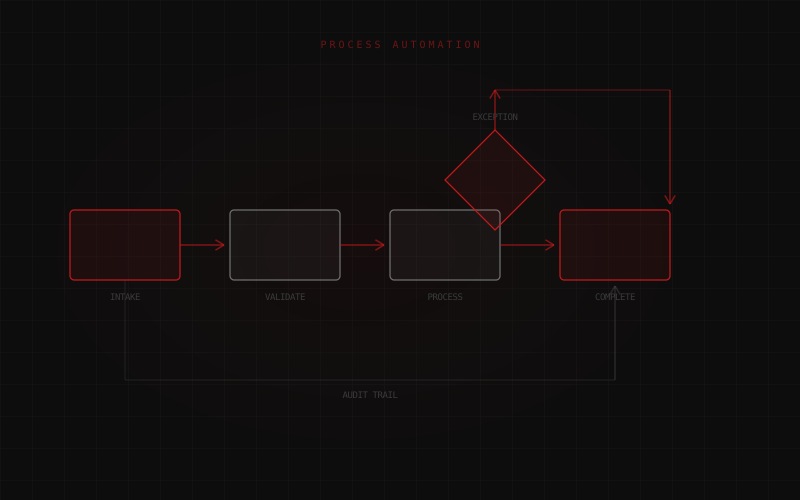
Engagements begin with a documented lifecycle model: the stages a contact moves through, the scoring logic that determines stage transitions, the handover contract between marketing and sales, and the attribution method that will connect automated activity to revenue. Only once that architecture is agreed does platform selection or reconfiguration begin, whether that means implementing HubSpot, Marketo, or Salesforce Marketing Cloud from scratch or rebuilding logic inside an existing licence. Scoring models are recalibrated quarterly against closed-won data, and every nurture sequence is measured on stage progression and pipeline contribution, not open rates.
01
Lifecycle Architecture Design
Document the lifecycle model first: the stages a contact moves through, scoring logic for stage transitions, the marketing-to-sales handover contract, and the attribution method connecting activity to revenue.
02
Platform Selection and Build
Once the architecture is agreed, select and configure the platform to execute it, whether implementing HubSpot, Marketo, or Salesforce Marketing Cloud from scratch or rebuilding logic inside an existing licence.
03
Nurture and Sync Deployment
Build nurture tracks segmented by buyer profile, lifecycle stage, and entry source, with bidirectional CRM sync, audited field mappings, and suppression logic defined for every sequence.
04
Quarterly Scoring Recalibration
Recalibrate scoring models quarterly against closed-won data, and measure every nurture sequence on stage progression and pipeline contribution, not open rates.
If the automation platform is fully licensed but sales still ignores the lead scores and marketing still cannot attribute pipeline, the problem is the architecture, not the software.
DAM Networks designs marketing automation as lifecycle architecture first and platform configuration second. Engagements begin with an audit of the current scoring, sync, and attribution logic.
None by default, because the platform decision depends on the lifecycle architecture, the CRM already in place, and the team that will operate the system. HubSpot suits organisations that want marketing, CRM, and reporting in one system with moderate technical overhead. Marketo and Salesforce Marketing Cloud suit larger organisations with complex routing, multiple business units, and dedicated operations staff. The cost difference is material: total annual cost including licence and operations typically ranges from 30,000 to well over 200,000 dollars depending on the tier and contact volume. Designing the architecture first prevents paying for capability the lifecycle model will never use.
Scoring fails when it is built by marketing alone and left static. A working model separates fit scoring (company size, industry, role, region) from behaviour scoring (content engaged, pages visited, event attendance) and sets the sales-ready threshold jointly with the sales leadership that will receive the leads. The model then has to be validated against outcomes: within one to two quarters, the scores of leads that converted to opportunities should be compared against the scores of leads that were rejected, and the weightings adjusted. In most enterprise deployments the first model is 40 to 60 percent accurate against actual conversion; two or three quarterly recalibrations typically bring it to a level where sales stops re-qualifying every lead manually. A score sales does not trust is functionally no score at all.
The architecture and design phase typically takes four to six weeks, covering lifecycle definition, scoring design, CRM sync mapping, and the initial sequence plan. Platform implementation and the first set of live sequences usually take another six to ten weeks depending on data quality and integration complexity. Early operational metrics (sequence engagement, routing accuracy, sync integrity) are visible within the first month of go-live. Pipeline-level evidence takes longer because it depends on the sales cycle: for organisations with 60 to 120 day cycles, expect one to two quarters before attribution reporting shows a defensible pipeline contribution. Implementations that promise revenue impact in the first month are usually reporting activity metrics, not commercial ones.
We use cookies to improve this site.We use cookies to understand how the site is used and to improve it. You can accept all cookies or continue with only what is needed. See our Privacy Policy.